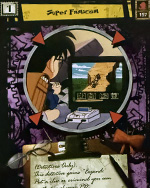
 Publisher: Score
Summary
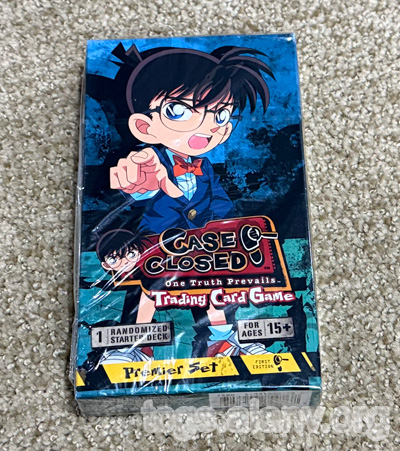
The Case Closed Trading Card Game is a card game published by Score, based on the anime series Detective Conan. In the game, you use detectives to overcome opposing problems and find clues to solve cases.
Unusually, the game is played with three separate decks of cards: a deck of cases, a "problem" deck consisting of criminals and clues and obstacles, and a "main" deck consisting of detectives and events and gadgets.
The game was distributed in starter decks and 10-card booster packs.
Card Types
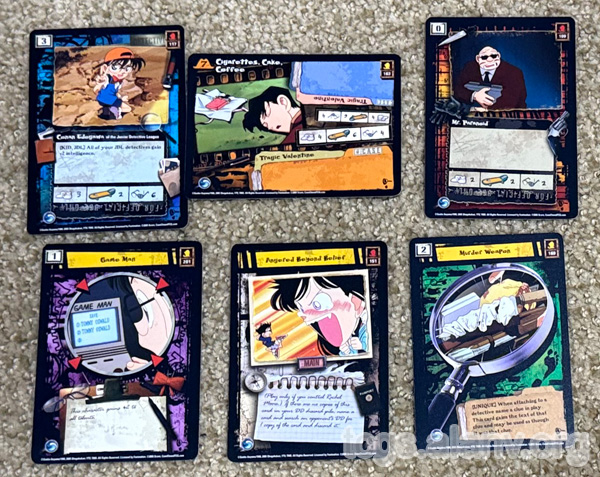
- Detective - Cards representing detective characters who help solve cases. Each has a cost (in job points) and talents (strength, speed, and intelligence). They may also have traits and effects.
- Criminal - Cards representing opposing characters who thwart your progress. Each has a cost (in crime points) and talents (strength, speed, and intelligence). They may also have traits and effects.
- Gadget - Cards representing items used by detectives. Each has an effect and a cost (in job points).
- Case - Cards representing cases to solve. Each has a clue value, list of clues, and talent goals to solve.
- Clue - Cards representing clues that help solve cases. Each has a cost (in crime points) and an effect.
- Event - Cards representing random events. Each has a play step and an effect.
- Obstacle - Cards representing things thwarting an investigation. Each has a cost (in crime points) and an effect. Added in the Crime and Punishment set.
Sets and Decks
The game saw a total of two released: Premier and Crime and Punishment. There were also promo cards.
The Premier set had starter decks released. The game only had three rarities (common, uncommon, and rare).
Deck Composition and Contents
Starter Decks
Decks: Blind Boxes
Players: One
Size: Full Non-Legal Deck
Rarities: Common, Uncommon, Rare
Rulebook: Included
Playmat: Included
Other Items: None
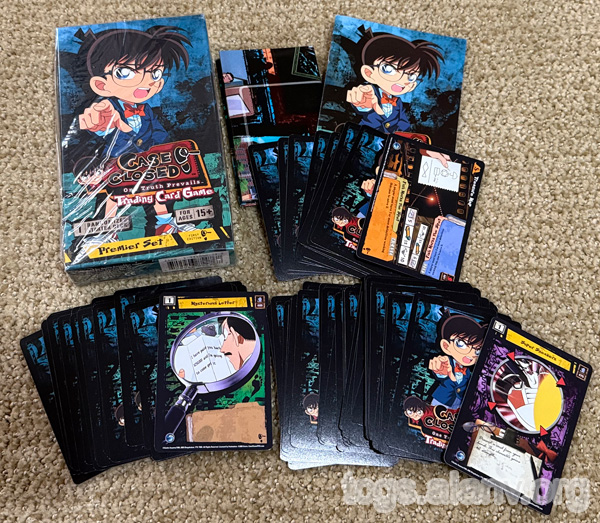
There was only one starter deck available, in the Premier set. They were semi-randomized, but in a way that would create a fairly playable deck.
Each deck came with 12 fixed cards (4 detectives, 4 cases, and 4 matching clues), as well as 60 additional random cards, divided into a 20-card problem deck (criminals and clues) and a 40 card draw deck (events, detectives, and gadgets). In this manner, the decks were playable.
A legal deck is 5-20 cases, a 40-60 card main deck, and a 20-card problem deck, so the contents of the starter almost make a legal deck. They could have easily made this a legal deck by including one additional case and reducing the randomized problem deck (since a starter contains 4 cases, a 44-card main deck, and a 24-card problem deck, when the fixed cards are included). Oh well.
Within those 20 and 40 random cards, there are 40 common cards, 15 uncommon cards, and 5 rare cards. The randomized problem deck consists of 13 common, 2 rare, and 5 uncommon cards, and the randomized main deck consists of 23 common, 3 rare, and 14 uncommon cards. Duplicate cards are possible. The 12 fixed cards consist of 3 uncommon and 1 common detectives, 4 uncommon cases (no common cases exist in the set), and 4 common clues.
Deck Rarity Analysis
Amazing. None of the fixed cards are rare, so they don't spoil any booster packs. And then every starter comes with 5 (!) rare cards, which is also fantastic. The rares are split between the two decks, so you can theoretically get any rare detective, criminal, gadget, clue, or event card in a starter deck, which is great.
The lack of any randomized case cards in starters is interesting, since that means the only way to get cases that aren't the four fixed starter deck ones is to open booster packs. But from a rarity standpoint, this isn't a huge deal.
This doesn't affect rarity at all, but as a collector: What the hell is this card ordering? Every card in a set is numbered, so there is a definitive order to a set, and for the most part cards are arranged in blocks by type and rarity (common clues, common criminals, common detectives, common events, common gadgets, uncommon cases, uncommon clues, etc.). But this isn't always the case, and many cards seem to be inserted somewhat willy nilly. Card 146 is an uncommon gadget in the middle of a block of uncommon events. 142 and 143 are rare events outside the block of rare events (160 to 194). Card 1 is an uncommon clue, followed by 11 common clues. Also, nothing is alphabetically arranged within a block (or arranged based on anything I can identify). As a collector, putting these cards in a binder in the canonical ordering would be incredibly frustrating. What?
Alan's Thoughts On The Game
Will be updated once I've played the game.
Resources
- Card Game Collector (includes rules, info, and a full card listing)
- Starter Deck Card List (AlanvDotOrg Randomjunk)