 Publisher: Panini
Summary
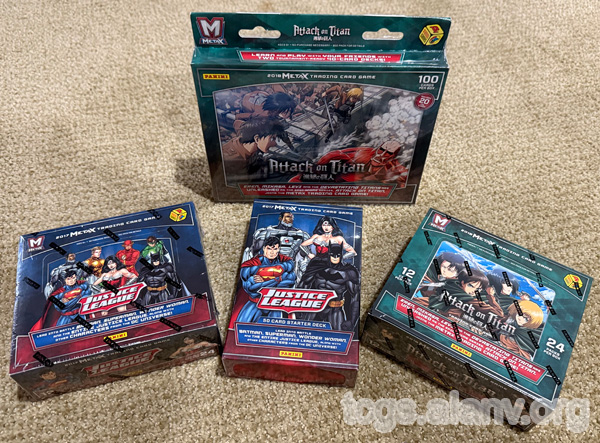
Meta X (pronounced "Meta Cross") is a card game system by Panini, which primarily features DC superheroes but also has an Attack on Titan set. In the game, control various characters as they engage in combat and break through enemy lines to score points.
The game was distributed in one-player starter decks, two-player starter decks, and 12-card booster packs.
It is similar to the VS system, and the Attack on Titan set should not be confused for the Union Arena set or the UniVersus set.
Card Types
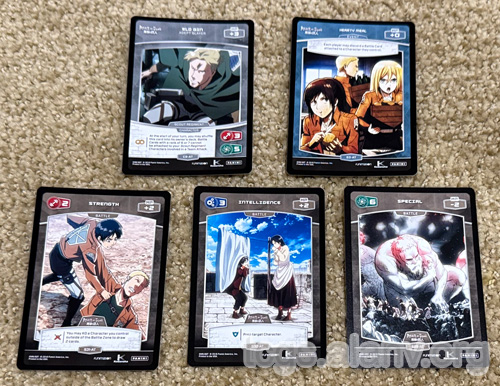
- Characters - Cards representing various people (and some animals), which fight each other. Each has an MP value, between one and three stats (strength, intelligence, and special), and an effect. Divides (roughly) into heroes, villains, and other (with different background colors), although this has no direct effect on gameplay.
- Battle - Cards used as part of a fight between two (or more) characters. Each has an MP value, one or more stats (and values), and may have an effect. Battle cards without effects are "basic" battle cards.
- Event - Cards representing random occurrences. Each has an MP value and an effect.
Sets and Decks
The game saw a total of four sets released: Justice League, Batman, Attack on Titan, and Green Lantern. A fifth set based around Teen Titans Go! was announced (and some teaser images of cards can be found online), but the set was never released.
Justice League had one-player starter decks, and Attack on Titan had two-player starter decks. All sets had booster packs.
All sets include cross-rare, ultra-rare, and foil cards. There were also a few promos.
Deck Composition and Contents
One-Player Starter Deck
Decks: Blind Boxes
Players: One
Size: Full Legal Deck
Rarities: Starter
Rulebook: Included
Playmat: Included
Other Items: None
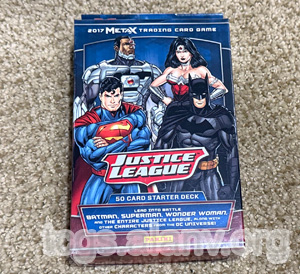
There are four different starter decks available from Justice League: Bat Family, Superfriends, Evil United, and Justice Swarm. Each deck features a full 40 card deck and 10 "random" foil cards, which are not intended to be used in the deck. (A legal deck is 40 cards.)
Starter deck contents were fixed, but boxes do not indicate which deck is inside. A deck contains only starter-only rarity cards, although many cards are reprints of cards available in booster packs, just with alternate art. Starter decks seem like they may also be the only way to get "basic" battle cards, which makes them pretty important.
The foil cards are not entirely random; each 40-card deck always comes in a specific order, and the 10 foil cards are always a run of 10 cards from the matching (and included) starter deck.
Two-Player Starter Deck
Decks: All Same
Players: Two
Size: Full Legal Decks
Rarities: Common, Uncommon, Rare, Promo, Starter
Rulebook: Included
Playmat: Included
Other Items: None
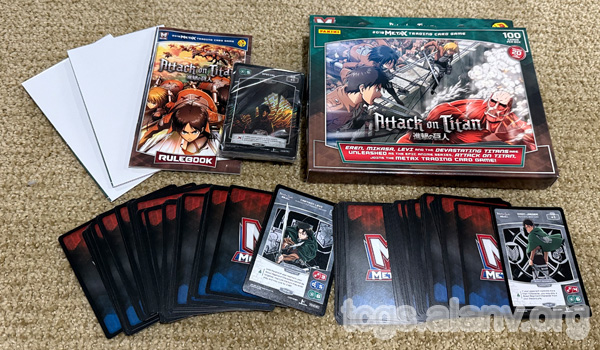
Only one two-player starter deck is available, in the Attack on Titan set. Each deck features two 40-card decks and 20 "random" foil cards, which are not intended to be used in the deck. (A legal deck is 40 cards.)
Starter deck contents were fixed, and there's only one deck, so all Attack on Titan two-player starters have the same 80 cards. Each 40-card deck deck has two copies of one rare card, one deck has two copies of one promo card, and the remaining cards across the decks are common, uncommon, and starter-only rarity. As before, starter decks seem like they may also be the only way to get "basic" battle cards, which makes them pretty important.
The foil cards are not entirely random. Rather, the two 40-card decks divide into two half-decks each, and the 20 foils will be one of the four half decks.
Justice League Demo Decks
Decks: All Same
Players: Two
Size: Tiny Demo-Only Deck
Rarities: Common, Starter
Rulebook: Included*
Playmat: Included
Other Items: None
These demo decks feature 16 cards, broken into two decks. Cards include are common and starter-only rarity. (Interestingly, none of the characters featured on the box [Batman, Superman, and Wonder Woman] are found in the box.)
*Each demo deck comes with a turn-by-turn walkthrough sheet, in place of a full rulebook. It also includes two playmats.
Unlike the PanZ demo decks, nothing here is exclusive, so there's not a real reason to acquire any of these.
Attack On Titan Demo Decks
Decks: All Same
Players: Two
Size: Tiny Demo-Only Deck
Rarities: Common, Uncommon, Rare, Starter
Rulebook: Included*
Playmat: Included
Other Items: None
These demo decks feature 24 cards, broken into two decks. Cards included are common, uncommon, rare, and starter-only rarity.
*Each demo deck comes with a turn-by-turn walkthrough sheet, in place of a full rulebook. It also includes two playmats.
Unlike the PanZ demo decks, nothing here is exclusive, so there's not a real reason to acquire any of these.
Deck Rarity Analysis
The one-player starters are great. As with PanZ, the decks contain only starter-only rarity cards, and they're blind-packed. But it seemed Panini learned from PanZ, because there are a more reasonable 4 decks (compared to the 6 per set with DBZ), meaning you'd only need an average of 9 decks to get all 4. As before, a box of 10 starter decks contains all four decks. The fact that cards are mostly just reprints of booster pack cards (with alternate art) is great for players. It's also not terrible for collectors, especially if you're buying a box of 10 starters.
The two-player decks are... confusingly horrible, given how much Panini did right with its other starters (for both this and PanZ). Each of the two 40-card decks includes two copies of one rare card. One of the decks includes two copies of a promo card. Across the two decks, there are also two copies of each of 5 uncommon cards, and two copies of each of 4 common cards. This is already not great, since it largely spoils two rare cards from boosters (Crawling Titan and Mikasa Ackermann).
What makes this horrible though is the foil cards. Foil cards can be randomly found in booster packs. You can therefore spoil foil versions of the two rare cards (as well as many of the common and uncommon cards) from a starter. This is particularly bad because of how the cards in the decks are ordered. The Justice League one-player starter decks have cards in a non-duplicated sequence; that is, you will not find two of the same card in a row (or even within 10 cards of its other copies), so the 10-card foil pack will contain 10 unique cards (all starter-only rarity). With the Attack on Titan two-player starters, the majority of the deck is doubled up (including both rares). This means your foil pack will definitely contain two copies of at four different cards (and may simply contain two copies of 10 different cards), and if it contains a rare card (a 50% chance), it will contain two copies of that foiled rare card.
This is baffling given how great Panini had been doing. These starter decks would be pretty average from a rarity standpoint if not for the foils.
Alan's Thoughts On The Game
I want to love this game, because it does a lot of interesting things. Different types of KO leads to interesting decisions around which character to defend with. Link to try and guarantee a point versus attacking twice and saving the MP. Heck, even the fact that playing many cards gives you resources to play other cards (MP) is interesting. There's a lot in here to like.
My problem with this game is card draw. It's entirely possible that this is a me problem (and I'm fundamentally misunderstanding something about the rules), but you're spending cards not only on your turn, but during your opponent's turn (since defending an attack requires a battle card). This seems like it should create interesting decisions of whether or not you defend an attack in addition to whether or not you push a character (on your turn) or leave it able to defend... and it does, at the beginning of the game, when you have a lot of cards. But then your hand gets down, and games for me have quickly degraded to "It's my turn and I drew a battle card so I'll attack you and you have no battle cards to defend so it's an auto point, and you'll do the same to me during your turn", which is decidedly not interesting.
There are a good number of draw mechanics in the starter decks, but the sheer importance of cards makes that drip too meager, and makes luck of the draw particularly problematic. In the absence of a desire to build (and test) custom decks to facilitate card draw, I want to try a house rule to "even up" your hand at the beginning of your turn rather than drawing a single card. I feel like it would lead to more interesting decisions.
Thematically, the inclusion of Attack on Titan with superheroes is also slightly strange to me, but I can only assume they were intending on including other properties when the game died, so I can probably give this a pass. And they really screwed up the AoT starter decks for collectors, but that isn't a complaint about the game itself, so I also can't criticize it too much for this.
Side note: I love the card layouts, and how they really give a lot of room to the art. This is a much prettier superhero game than VS System, even though I really appreciated VS' original art.
Resources
- Starter Deck Card Lists (AlanvDotOrg Randomjunk)