 Publisher: Decipher
Summary
.hack//ENEMY (pronounced "dot hack enemy") was a collectable card game from Decipher set in the .hack universe, which itself is based around an MMORPG called "The World". In the game, you play monster cards to fight player character (PC) cards, defeating them to earn victory points depending on the monster.
The game was distributed in starter decks, preconstructed decks, 11-card booster packs, a "GIFT" pack, and tournament and promotional cards.
Card Types
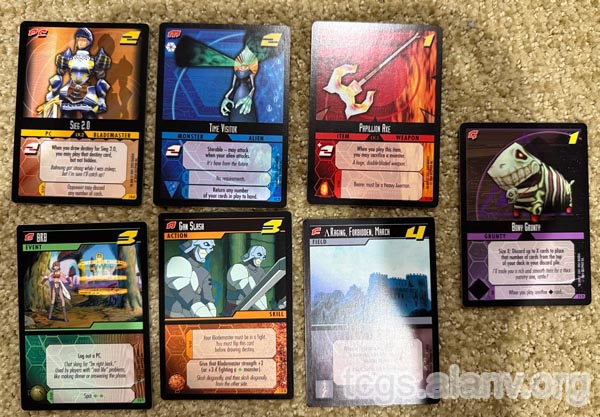
- PC (Player Character) - Cards representing various characters in The World, each in one of six "classes": Blademaster, Heavy Axeman, Heavy Blade, Long Arm, Twin Blade, and Wavemaster. PCs can also be tagged as "Knight"s or "Queen"s. These classes (and tagging) affects what cards and effects can be used with the PC. Each also has a strength, and may have a play requirement and a game effect.
- Monster - The most crucial cards in the game, representing monsters in The World that will attack the PCs. Each has one of six elements (fire, water, earth, wood, thunder, and darkness) or can be non-elemental, a number of victory points they will score in a successful battle (ranging from 0 to 6), a strength, and victory effect, and a play requirement and play effect. Monsters can also be "storable", allowing you to build up an army of multiple monsters before unleashing them all at once upon your opponent(s).
- Item - Cards representing gear worn by PCs. Attaches to PC cards to add strength, defense, or other effects. In later sets, items could allow you to play Action cards from your hand. Also has one of the six elements (or is non-elemental).
- Action - Cards that are typically played face-down and flipped during combat to add strength, defense, or other effects to PCs. Also has one of the six elements.
- Event - One-time effect cards that have various effects when played. Also has one of the six elements.
- Field - Ongoing effect cards representing the battle environment. Also has one of the six elements.
- Grunty - Small creatures you "feed" cards to for effects. Six exist in the game, each aligned with an element.
- Level Up! - A special effectless card only obtained from tournaments, which are spent as a cost to play powerful event cards (also only obtained from tournaments).
Sets and Decks
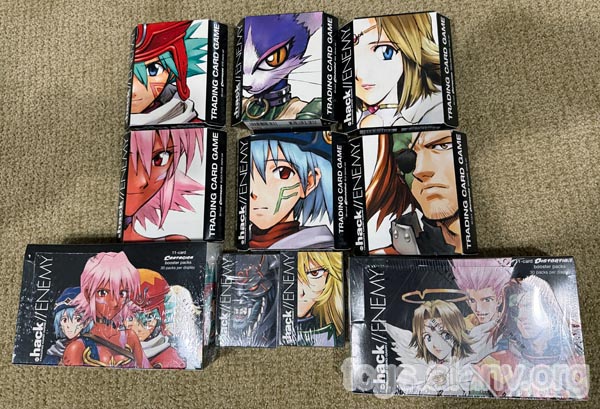
The game saw a total of five sets released: Contagion, Distortion, Epidemic, Isolation, and Breakout. It also had a special set GIFT (with alternate art versions of extra-rare PCs from Contagion), tournament-specific cards, and various promotional cards.
The first three sets (Contagion, Distortion, and Epidemic) had starter decks released with the sets. Isolation had preconstructed decks instead. Breakout did not have any decks associated. Booster packs were available for the standard five sets.
All sets include extra-rare cards. (Also worth noting is that starter and extra-rare cards in the first four sets were all foiled, while Breakout extra-rares were not foiled.)
Deck Composition and Contents
Starter Decks
Decks: Box Indicates Contents
Players: One
Size: Full Legal Deck
Rarities: Common, Uncommon, Starter
Rulebook: Included
Playmat: Included
Other Items: Survey Sheet
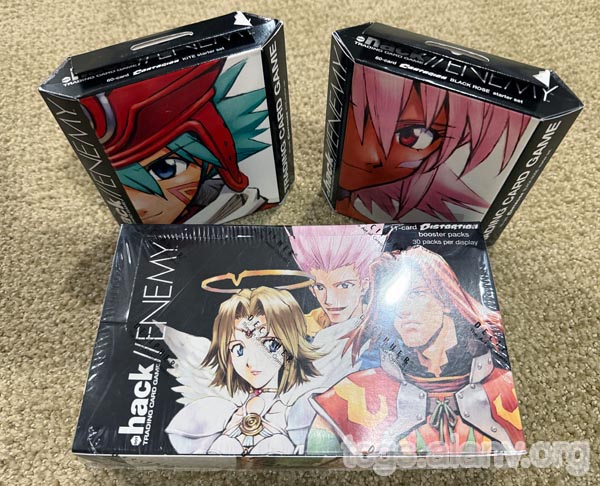
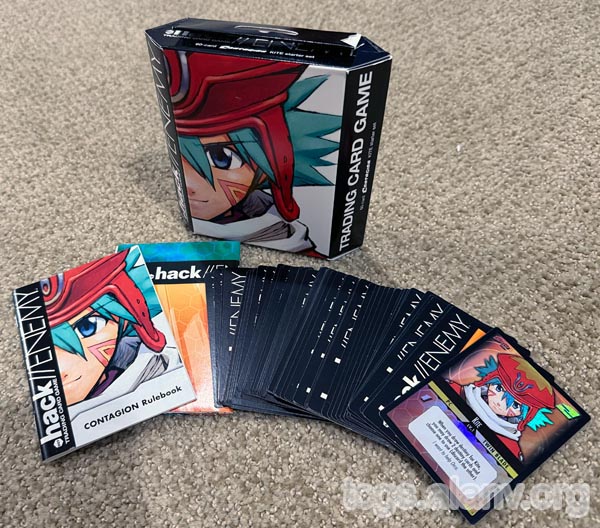
The six starter decks were each themed around a specific PC (Kite and BlackRose for Contagion, Terajimo Ryoko and Sanjuro for Distortion, and Mia and Elk for Epidemic). Each came with a 60 card deck (each including 5 foiled cards found only in the starter decks, including the namesake PC), a rulebook, and a playmat. The deck boxes also had a unique shape, being stretched hexagons in profile.
Starter deck contents were fixed, and the boxes indicated which deck you would get. The decks themselves are a mix of common and uncommon cards, together with the 5 foiled starter-only rarity cards.

Preconstructed Decks
Decks: Box Indicates Contents
Players: One
Size: Full Legal Deck
Rarities: Common, Uncommon, Starter
Rulebook: Not Included
Playmat: Not Included
Other Items: None
Two preconstructed decks (Gardenia and Marlo) were released with the fourth (Isolation) set. Like the starters, they came with a 60 card deck, each including 5 foiled cards found only in the decks (including the namesake PC). Unlike the starters, these decks did not include a rulebook or playmat, and were regular rectangular shaped.
Preconstructed deck contents were fixed, and the boxes indicated which deck you would get. The decks themselves are a mix of common and uncommon cards, together with the 5 foiled starter-only rarity cards.
Deck Rarity Analysis
Since the first expansion, .hack//ENEMY has done rarity amazingly well (one of the best games from that standpoint). Each deck includes 5 (foiled) starter-only cards, and no rare cards, meaning that booster packs will not duplicate rares from your starter decks. The fact that the decks are also clearly marked with the character means you won't acquire multiples of the starter-only cards unless you intend to. Fantastic, all around.
Alan's Thoughts On The Game
.hack//ENEMY is one of my favorite TCGs. A lot of this may be because of nostalgia, with how my undergrad group of friends played the game with me and we developed several in-jokes from it (Yeah Piros goes to the doctor!). But I also just think it's a good game, and for a long time (after it went defunct), it was inherently affordable even for a poor undergrad (with a booster box of 30 packs running under $10).
I've always enjoyed games with relatively simple rules. While (like most TCGs) complexity can be introduced via cards, it still remains simpler to learn than most other TCGs. It also doesn't involve any fiddly pieces (no dice, no damage markers, no condition markers), and if you don't care about building a national-competition-worthy-deck (which I obviously don't), deckbuilding is relatively free and open, with a huge number of monster families that you can combine with basically any PC class.
The game itself is also just fun. There's nothing like filling your portal with a bunch of snakes and lizards and unleashing them all at once, or facing off against a deck of fish that is hilarious and underpowered. You also don't need to fill a deck with rare cards, and in many cases can't, as you need some of the more common (and uncommon) enemies to enable the rares (and extra rares) to be playable. The play requirements of cards generally force a balanced deck.
Destiny adds a fun deckbuilding aspect too, where you can build a deck with more limited direct power but higher destinies, or take the gamble with stronger cards at the risk of destiny draws of 1. It's a card balance aspect they did well.
I'm also impressed by how little the game suffers from power creep. While there's definitely some aspect of that (especially around phase monsters from the Breakout set), in general, cards from the first set remain completely viable (and, in many cases, crucial). As mentioned, destiny is a good power balancing mechanic (as well as the points on enemies), and the enemy rewards helps too, which makes a stronger (but lower destiny) monster not inherently better than a weaker enemy with 5 destiny and a good ability (but no points).
Overall, I think the game hits the right combination of affordability (now that it's defunct), accessibility (simple rules to get anyone playing quickly), and depth.
Resources
- Unofficial Fan Site (includes rules, info, and a full card listing)
- Starter Deck Card Lists (AlanvDotOrg Randomjunk)