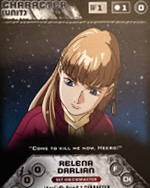
 Publisher: Bandai
Summary
Gundam War is a collectable card game by Bandai, combining the various Gundam series into a single card game. In the game, you build Gundams and send them to fight your opponent to deplete their nation pile (deck).
The game saw significant success in Japan, but was less successful in the US. The English version of the game was available in a two-player starter deck and 10-card booster packs.
The game should not be confused with the Gundam M.S. War TCG (also by Bandai) from 2001, nor the Gundam Card Game from 2024 (also by Bandai).
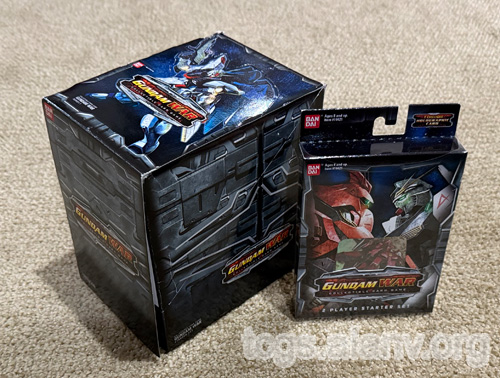
Card Types
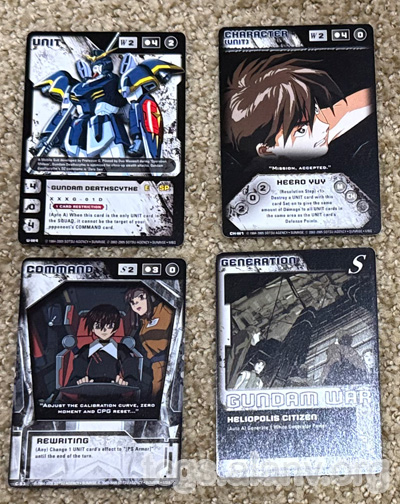
- Unit - Cards representing gundams or other large combat units (such as battleships or fortresses). Each has a cost (corps plus total generator power, and card cost), battle points (strike, shooting, and defense), a type (earth or space, or both), and may have effects. Each belongs to a specific color and faction.
- Character - Cards representing people in the Gundam universe. These attach to units and have a cost, battle points, various types (male or female, adult or child, New Type or Coordinator), and may have effects.
- Command - Cards representing special events, which can change the course of battle. Each has a cost and an effect. Each belongs to a specific color and faction.
- Operation - Cards representing military operations or strategies. Each has a cost and an effect. Each belongs to a specific color and faction.
- Generation - Cards representing manpower and technology, which provide generator power to play other cards. They are either basic or special, and belong to a color. Each belongs to a specific color and faction.
Sets and Decks
The game saw a total of three sets released in English: Now and Forever, First Strike, and Binding Fate. There were also promotional cards. The first set (Now and Forever) had a two-player starter deck.
(The Japanese printing of this game lasted 19 years and spanned 45 sets.)
The game does not appear to have cards higher than rare difficulty (although full card lists are hard to come by, online). However, were were also promo cards available.
Deck Composition and Contents
Starter Decks
Decks: All Same
Players: One or Two
Size: Two Reduced Legal Decks or Full Legal Deck
Rarities: Common, Starter
Rulebook: Included
Playmat: Included
Other Items: None
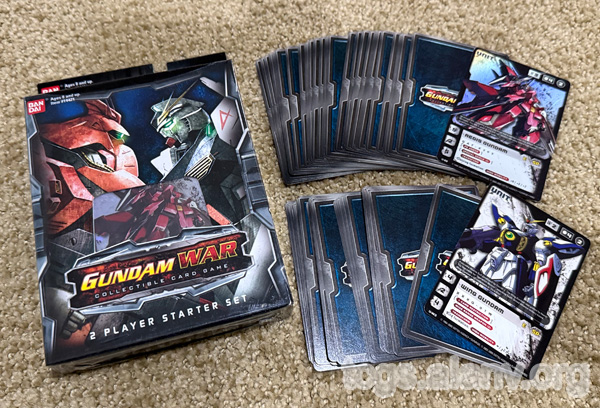
One starter deck was available for the game. It came with 60 cards, which divided into two 30-card decks for Gundam War and Gundam SEED. These are both in the White color (but different factions), so the two decks can be combined into a single full deck. (A legal deck is 50 or more cards.)
Starter deck contents were fixed, and all starter decks contained the same cards. The deck came with one foil card (the Aegis Gundam). Most of the other cards were starter-only rarity, although a few were common (and could be found in Now and Forever booster packs).
Decks also included a two-sided playmat (two players on one playmat, or one larger side for one player) and a rulebook.
Deck Rarity Analysis
Great. Starter-only rarity and a few commons? This is almost perfect.
I do want to note that, like the Knights of the Zodiac card game, cards do not indicate their rarity anywhere and the numbering on cards continues across sets. This makes it impossible to understand what cards are in what sets, and whether you've collected all of a set. Like KotZ, this is extremely poor for collectors.
One interesting outcome of there only being one starter deck in a game with strong color divisions: It is very expensive to build a deck in any color other than White. This doesn't matter from a collector's standpoint, but for players, you're looking at a serious investment in booster packs.
Alan's Thoughts On The Game
This is one of the most frustrating games I've ever attempted to play. Much like the Knights of the Zodiac card game (also by Bandai), I have never finished a full game of it. Unlike KotZ, the issue with this game isn't its core gameplay. That actually seems reasonable. It's a combination of incredibly specific and badly named rules with an extreme number of keywords that are not expanded out on the cards.
For example, there are four different "Auto" abilities, called "Auto A", "Auto B", "Auto C", and "Auto D", and they all have fundamentally different rules (A is active while in play and can be "cut-in" AKA interrupted, B is valid whether it's in play or not and cannot be cut-in, C has specific timing and can be cut-in, D has specific timing and cannot be cut-in). This is... ridiculous. I'm sure you'll learn this if you really get into the game, but someone new approaching the game is going to be constantly trying to remember what these mean. These would have been far, far better expressed on the card as something like "(Constant No Cut-In) While in play or not, X effect.".
Also things that should be explained on the cards: keywords. Practically every card has one or more keywords on it. I describe this game as keyword hell, because the starter rulebook lists 30 keyword effects, none of which have effects written out on the cards. Some of them are somewhat self-explanatory ("Set-on / CHARACTER" means you attach this to a character card), some you can somewhat remember after looking them up ("Battleship" means you can attach infinite characters but the characters don't apply their battle points), while others really require you to reference the rulebook (Voucher: "(Auto D) When you are in battle and your squad consists of all Voucher unit cards, you earn "Voucher Points" equal to the total generator power of every unit card (of either player) that is destroyed by you during that specific Battle. Voucher Points can be redeemed at the end of your turn to retrieve one card from your Junkyard to your hand, following the formula below: 2 or more Voucher Points = 1 generation card, 5 or more Voucher Points = 1 unit card or 1 character card, 8 or more Voucher Points = 1 command card or 1 operation card"). Just... what. Also it's Auto D which means you cannot cut-in to its effect. Which is different than if it was Auto C which means you could cut-in. What.
There are also more minor things, like "reroll" meaning the card is not tapped (versus "roll", which means it is; "unroll" would have been a better term), and the battle points not having labels on the cards (so you have to remember the order as strike points, shooting points, and defense points). These are not really issues in isolation, but they're just additional signs that the designers did not have newbie-friendliness in mind for any aspect of the game.
Together, these issues make this a game where you can never just get into the game and play it. You're constantly grabbing the rulebook and looking up an effect from your hand, and then your opponent does the same when you play the card. It's incredibly frustrating, and turns relatively straightforward rules into a game that feels too intimidating to play.
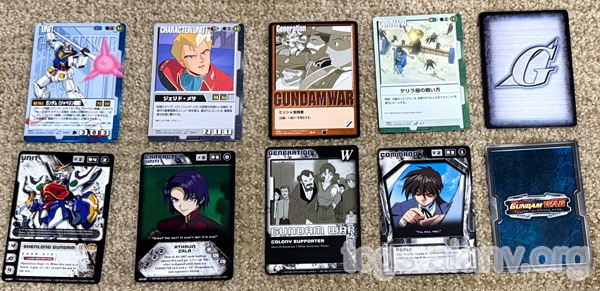
I have no idea if the original Japanese cards have this same problem of keyword hell. (They did change card templates for the English release, so it's possible they attempted to consolidate effects into keywords as part of the card translation, resulting in this mess. See a comparison of Japanese vs English cards below.)
It's a shame, really. This actually feels like it should be a reasonable game. It's just one that I can never play.
Resources
- Unofficial Fan Site (includes rules, info, and a full card listing)
- Starter Deck Card List (AlanvDotOrg Randomjunk)