 Publisher: Stone Blade Entertainment
Summary
Solforge Fusion is a card game by the creator of Magic: The Gathering, where the cards are algorithmically generated and therefore "unique" to your deck, like the similiar Keyforge game. You combine two different faction half-decks together in a single deck and fight your opponent(s) in lane-based combat with creatures and spells that upgrade as you play.
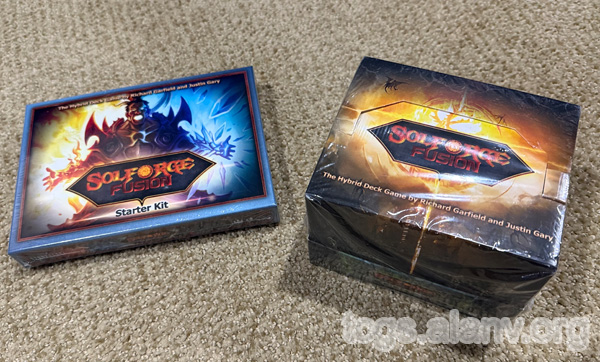
You can't really call this a "trading card game", as you can't trade individual cards with other players. You can kinda trade entire half-decks, but it's better to think about this game as a customizable card game, where you'll acquire multiple half decks and build a full deck using them. It's available in a 4 half-deck (120 card) starter kit and 4 half-deck booster kit, which differ only from starters in that they do not include playmats, counters, or forge and reference cards.
The game also has a digital version which can import your physical decks for virtual play, or buy virtual cards. We won't talk about the digital version at all here.
(Yes, this game is technically not defunct. No, I don't care, because old product is effectively being liquidated, so I'm going to count it as defunct enough to include in my list.)
Card Types
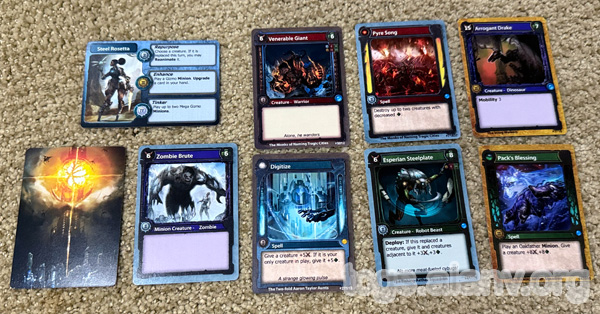
- Forge Born - A card representing the character you're playing as. Each belongs to a faction and has abilities that can be used in cycles 2-4.
- Creature - Cards representing units that fight in the lanes of combat. Each belongs to a faction, has an attack and health value, and may have an ability. Each creature in your deck will have three different cards for each of its three levels.
- Spell - Cards representing special one-time use abilities. Each belongs to a faction and an ability, and each has three different cards for each of its three levels.
- Minion - Creatures that are summoned or created as part of other effects, which are not part of your deck. Each has an attack and health value, and may have an ability, and plays to the lanes like creatures.
You'll also make use of a two-sided forge card, showing which player is the active player at any given moment.
Sets and Decks
The game has three sets: the base set, Whitefang Pass, and The Last Winter. Starter kits are only available for the base set, while booster kits are available for all three sets.
While cards in the sets technically have rarities (common or rare), that doesn't really make sense for a game where individual cards are never used outside their half-deck. They might be useful as an indicator of how unusual the cards or effects are on individual cards in the deck, but they don't have any real impact for collectors.
Deck Composition and Contents
Starter Kit
Decks: All Same
Players: Two
Size: Full Legal Deck
Rarities: Starter
Rulebook: Not Included
Playmat: Included
Other Items: Counters, Minion Cards
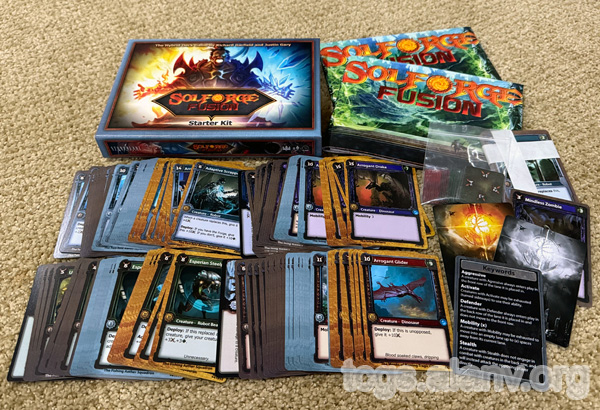
Each starter kit features four half-decks, one from each of the four factions. Each half-deck includes 30 cards and a Forge Born card (with the card list on its back) for the half-deck. As noted, all cards are algorithmically generated, and therefore no two half-decks are (theoretically) ever the same.
Each of the four half-decks also includes either a two-sided forge card (for turn priority), a reference card, or a minion card. (You'll get a total of two forge cards, one reference card, and one minion card across the four half-decks.)
Starter kits also come with playmats, counters for tracking damage and attack boosts, and additional minion cards for the various effects that create minions.
Two players can play with a single starter kit, as it can form two full 60-card decks.
Booster Kit
Decks: All Same
Players: Two
Size: Full Legal Deck
Rarities: Starter
Rulebook: Not Included
Playmat: Not Included
Other Items: Minion Cards
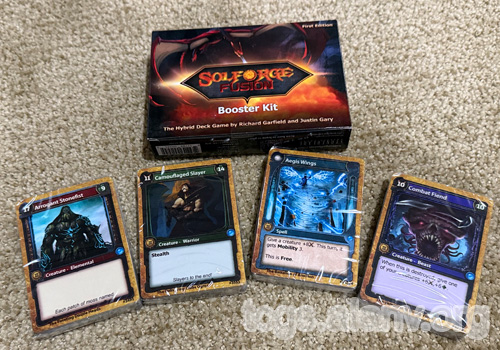
A booster kit contains four half-decks, one from each of the four factions. Each half-deck includes 30 cards and a Forge Born card (with the card list on its back) for the half-deck. As noted, all cards are algorithmically generated, and therefore no two half-decks are (theoretically) ever the same.
Each of the four half-decks in a booster kit also includes one minion card. The minion card may not match the corresponding half-deck, and duplicate minions are possible in the box. (For example, my box included three zombie minions.)
I'm counting this as a "preconstructed deck" because (like the starter kit) you can grab a booster kit and make two full decks from it. Thus, two players can play with a single booster kit.
Deck Rarity Analysis
This isn't an analysis that makes sense for this game. Every half-deck is (theoretically) unique. Every booster kit contains more unique half-decks.
Alan's Thoughts On The Game
The concept of this game is fascinating to me. I never played KeyForge, but my understanding is that KeyForge just gave you a (algorithmically-generated) deck, and you played with it. You could get more decks for more options, but you couldn't customize the deck in any way. That makes SolForge's answer to customization ("fusing" two half-decks together) a really interesting one, and necessary in an algorithmically-generated game (with no card costs) where certain cards are just going to be better than others and it's up to the contents of the half-deck as a whole to be balanced.
From a gameplay standpoint, it's a really good game. The lane-based combat works pretty well, and forces strategic choice in creature plays. The upgrading aspect is really interesting, and I really enjoy it. The offense vs defense of the current forge player is an interesting mechanic, as going second gives you the ability to better react, but at the cost of (usually) being able to directly damage the opponent. The gameplay effects themselves (and how well they actually work with the other cards) vary wildly between decks, but each faction does attempt to have its own "feel", and finding a combination of half-decks that works for you is interesting.
But that's also where the algorithmic nature of the game comes in. You'll find yourself in situations where you have an effect that wants (for example) a robot in play, or where you'll want to destroy one of your creatures for an effect, but you won't have the right cards to do so. Normally this would just be a "Oh yeah, these are starter decks, so I can customize the deck to robots so this isn't an issue", but... you can't. The nature of the game forces you to play each hand within the current state of the game, and that's what's really fascinating about this... there's not really a lot of work beforehand to build your deck, because you're likely going to have a deck that doesn't always synergize with itself (or the other half deck it's paired with). The mechanic where you really only play two cards out of every hand of five helps balance this, because you're not stuck with unusable cards, and get a clean slate of playing effects every round (more or less).
One side effect of this is also that you're going to spend time reading through your deck (through all upgrade stages) so you can understand how to play it, whether before the game starts or during the game itself, which is normally something you'd already know with a set's cards, and tune over multiple games with the same deck. The decks also vary in power (and what they do or don't pair well with.) This game's concept feels like it lends itself much more to a casual "let's grab two half decks and have it" approach for game nights (more like a board game than a TCG), and that could be an issue with groups (or individuals) who are obsessive about maximizing their play. Either way, this could result in slowing down gameplay, either during play (as you read your cards) or beforehand (as people read through their decks).
The game does feel a bit fiddly with tracking individual damage on creatures (and searching for an upgraded version of a card any time you play something), and tracking the attack/defense state changes, and especially remembering to upgrade cards (into your discard), but it doesn't really slow down or hurt the game. (But that really shows that this game was probably conceived as a digital game first, as this kind of tracking and even the upgrading are better suited to digital games.) The 5x2 grid you're forced to play on makes the game slightly more annoying without the playmat. But those feel like nitpicks.
One big thing that really did detract from the experience though was the lack of a printed rulebook, even in the starter kit. I hate having to pull my phone out before playing (and passing it around as necessary) and trying to refer to it during play. Huge negative points there. (The reference card helps, but it isn't a real solution to this.)
Regardless... As someone who's a collector, this game confuses me. As a player, this game amuses me. Overall, I like it... just please please please manufacturers, include a physical rulebook.
Side note: The card backs are horizontal. As with other card games with horizontal card backs: Why?