 Publisher: Super Heat Games
Summary
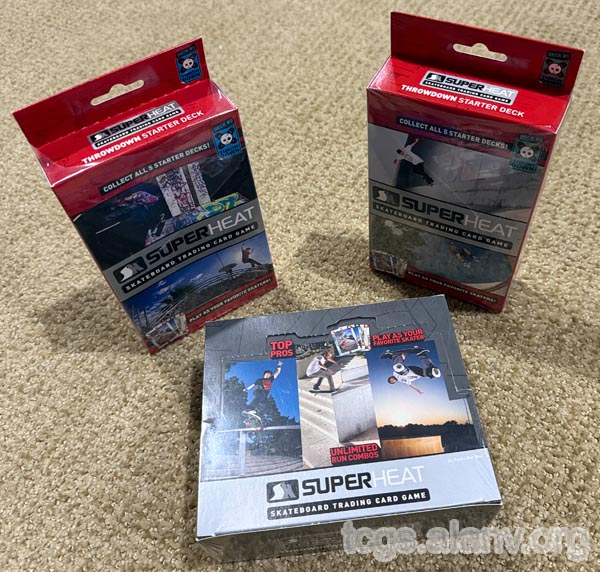
Superheat (Skateboard Trading Card Game) is a card game featuring skateboarders and their moves. The game emphasizes collectability, with starters including randomized "collector's cards" which are printed on extra-thick cards (with glossy highlights) but which are not usable in the game. The game itself involves playing cards to form "runs" based on physical positioning on a card, representing chains of moves that a skateboarder would perform. It was available in starter decks and 9-card booster packs.
Card Types
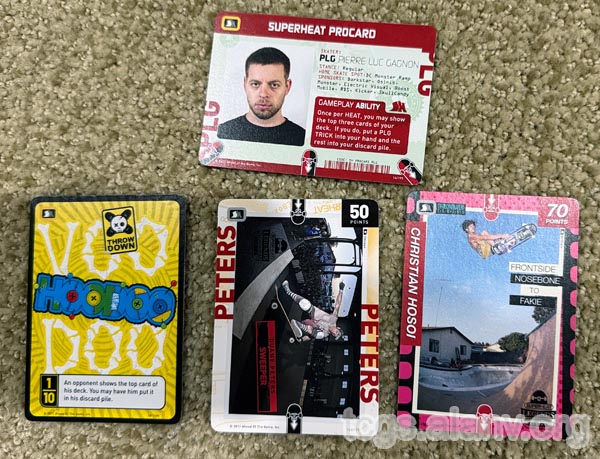
- Pro Card - Cards representing the skateboarders themselves. Every deck is based around one, and the card features an ability and three "slots" to start runs.
- Trick - Cards representing different skateboarding tricks, which are played as parts of "runs" on either a pro card or another trick. Trick cards all feature a skateboarder (although any trick can be used with any pro card), some lines to build from/to, and a point value, and some are printed with a self-proclaimed "throwback" styling (which has no impact on gameplay). Some tricks also have powers that trigger when they are played.
- Throwdown - Cards that have one-time-use effects.
Sets and Decks
The game only had one set (sometimes called Throwdown), which was available in five different starter decks and booster packs.
Deck Composition and Contents
Starter Decks
Decks: Box Indicates Contents
Players: One or Two
Size: Full Legal Deck or Two Legal Half Decks
Rarities: Common and Uncommon
Rulebook: Included
Playmat: Not Applicable
Other Items: Collector's Cards, Checklist Cards, Reference Card, Sticker
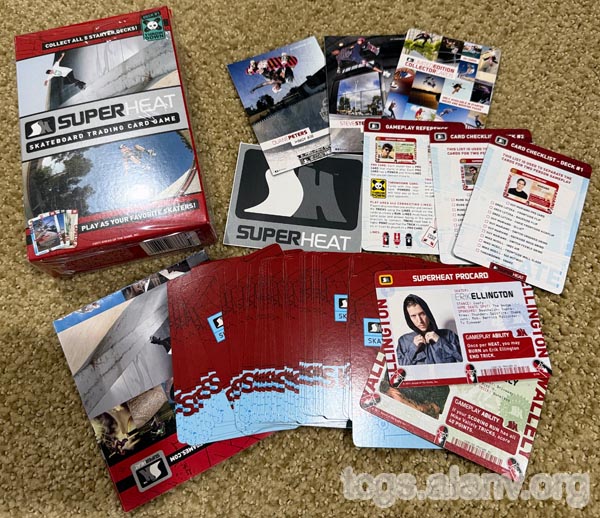
Each of the five starter decks features two different skateboarders, and the decks are numbered 1-5. The starter deck can either be used as a full legal 41-card deck by removing one of the two pro cards, or used as two separate 21-card decks for learning the game.
Starter deck contents were fixed, and the box number indicates which deck you would get. However, the two skateboarders within the deck are not indicated on the box itself.
In addition to the 42 game cards, the box also includes two randomized collector's cards (not usable for the game, and printed on thicker cards) with different skateboarders and their bios and stats, a collectable card checklist, a sticker, a gameplay reference card, and deck checklist cards (for separating the two 21-card decks apart if needed). The rules sheet had a poster on the other side (the same poster for all decks).
Note: The game does not really explain the rarity icon (I'm assuming common is silver, uncommon is gold, and rare is foil), so I'm assuming the starters consist of common and uncommon cards.
Deck Rarity Analysis
Starter decks do not include rare cards at all, which means booster packs will not duplicate rares from your starter decks. The fact that there are 5 different starter decks, and all are clearly marked on the box, means you can also avoid duplicating cards between starter decks.
Alan's Thoughts On The Game
This game is an interesting filler, but not much more than that. There is more strategic depth than you expect given the rules at first, because your pro has three lines you can start, and there's the aspect of color where you'd want to ensure other cards in your deck remain playable on a given line. But ultimately, there is way too much luck involved in the draws, especially given that the number of cards you draw in each heat hits 1 which you must then play (or bail on).
The abilities on cards can only mitigate this so much, and the majority of trick cards have no abilities anyway. Between such ability-less cards, some are just outright better than others based on the number of lines they have (and whether those lines are wild or not) and, while the range of points helps facilitate continued play between heats, it also means luck has even more of an impact on score, as a couple bad draws in a row will end the heat instead of adding high points.
I have not tried building decks in this game, but I suspect the answer will be to stock a deck with tricks that have lines of only one color (red or black) or which are wild, which would eliminate one limiting mechanic outright. After that, you'd maximize the number of outgoing lines on cards (prioritizing ones with two instead of one). This would have been greatly improved by an increased number of line colors, perhaps even tying specific mechanics to specific colors.
Additionally, throwdown cards are in an extremely weird space in this game. The limit of 10 "points" of throwdown per heat is effectively moot, because a throwdown is not contributing to your score and you're not going to stock enough of them in your deck to hit that limit.
Finally, storing your runs at the end of a heat is just tedious. Because tricks are vertical (rather than horizontal), the board also gets overfull very fast, meaning you have to pile your runs together and deal with the splits somehow. The game just takes up too much space and takes too much scoring time for a play experience that is average at best.
I would've loved to see some stronger tie between tricks and the pro who performs them (each trick features a certain pro, but this has no gameplay effect). I would've loved to see additional line colors, which could add more strategy in deckbuilding, with color-specific mechanics. I wish they had not done "throwback" card frames, which just adds visual confusion to the game with no gameplay impact. Had promise, but didn't really deliver.
Resources
- Official Website (via archive.org)
- Starter Deck Card Lists (AlanvDotOrg Randomjunk)