 Publisher: Upper Deck
Summary
VS System is a card game system by Upper Deck, combining multiple superhero properties (primarily DC and Marvel, but including one Hellboy set) into a single card game. The game involves pitting teams of superheroes (or villians) against each other to drain your opponent's endurance (AKA life).
The game should not be confused with the VS 2PCG, which is a later remake of the game with simplified rules. (2PCG is not an extension of VS System, and it is not compatible with this game.)
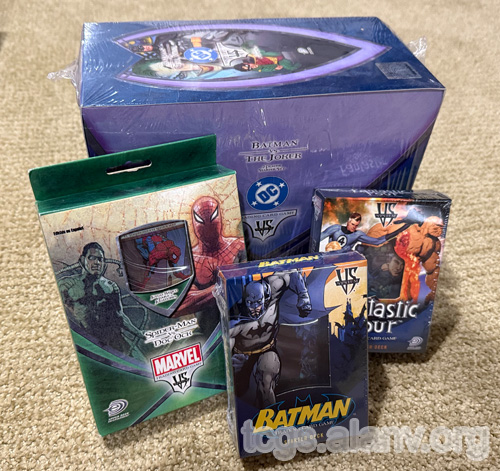
The game released with starter decks (in two different sizes) and 14-card booster packs. Products such as collector boxes were also available, and the game had an "all vs one" product (Galactus) that was similar to World of Warcraft's raid decks.
Card Types
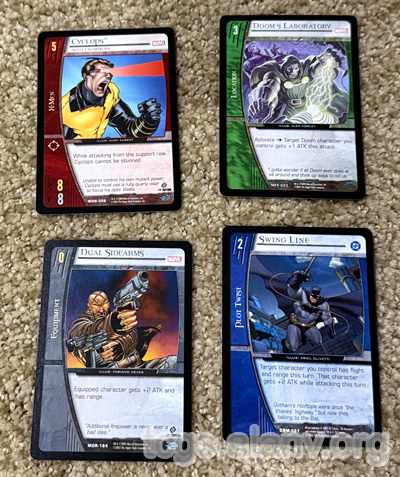
- Character - Cards representing heroes and villians who can fight. Each has a cost, attack, defense, an ability, and belongs to an affiliation. They may also have additional symbols (such as ranged and flying).
- Plot Twist - Cards representing unexpected events. These play as resources and can be flipped for a surprise effect. Each has a play threshhold and an effect.
- Location - Cards representing places. These play as resources, and can be flipped for ongoing effects. Each has a play threshhold and an effect.
- Equipment - Cards representing items or things that can be used. These have a cost and an effect.
Sets and Decks
The game saw 18 booster releases: Marvel Origins, DC Origins, Web of Spider-Man, Superman, Marvel Knights, Green Lantern Corps, The Avengers, Justice League of America, X-Men, Infinite Crisis, Heralds of Galactus, Legion of Super-Heroes, Marvel Team-Up, World's Finest, Marvel Legends, DC Comics Legends, Marvel Universe, and Marvel Evolution. Sets up to (and including) Superman had 1st edition printings. All sets had parallel foils.
There were two types of starter decks: VS decks, and standard starter decks. VS decks were released for three sets: X-Men vs The Brotherhood from Marvel Origins, Spider-Man vs Doc Ock from Web of Spider-Man, and Batman vs the Joker from DC Origins. There were also three standard starter decks that did not belong to any single set: Batman, Fantastic Four, and X-Men.
There was also a special Hellboy set that was available as a collector's box, and a Galactus deck that was an "all vs one" product. Other smaller sets (such as Marvel Exclusives and Marvel: Equipment) were also released, and there were promotional cards.
The system is pretty much split into Marvel and DC universes, with each card being so marked. While the game was active, this split was an important part of the card rotation schedule. Now, it has no real impact. The card templates also changed with the Marvel Legends set, which likewise has no gameplay impact.
Deck Composition and Contents
VS Decks
Decks: Box Indicates Contents
Players: Two
Size: Full Legal Deck or Two Reduced Legal Decks
Rarities: Common, Uncommon, Rare
Rulebook: Included
Playmat: Included
Other Items: None
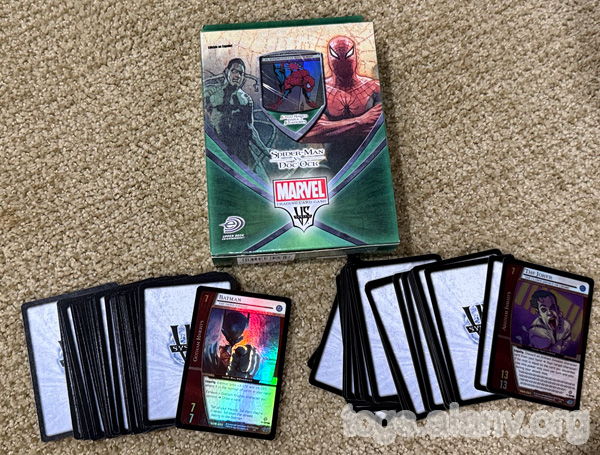
The 3 VS decks were larger two-player starter decks with 80 cards, consisting of two 40-card decks (one good, one evil). Each of the two 40-card decks included a foil card. (A full legal deck is 60 cards.)
Deck contents were fixed, and all of the same VS deck had the same cards (for example, all X-Men vs The Brotherhood decks had the same 80 cards). VS decks pulled their cards from a corresponding set, and included one rare foil card per 40-card deck, as well as 10-15 uncommons.
Each deck includes a full rulebook and a playmat.
Starter Decks
Decks: Box Indicates Contents
Players: Two
Size: Reduced Legal Deck or Two Reduced Legal Decks
Rarities: Starter
Rulebook: Included
Playmat: Not Included
Other Items: None
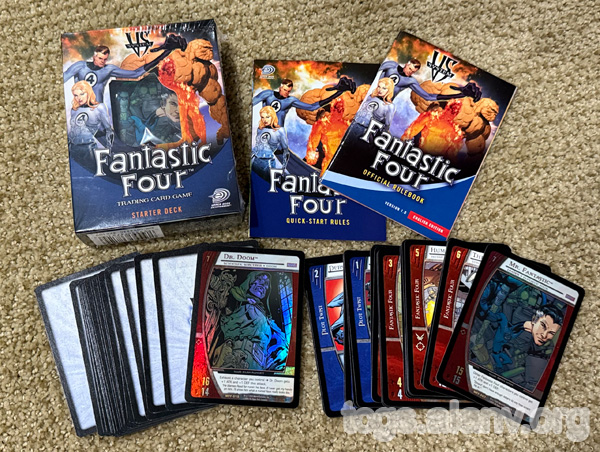
The 3 regular starter decks were smaller two-player decks with 52 cards, consisting of two 26-card decks (one good, one evil). Each of the two 26-card decks included a foil card. (A full legal deck is 60 cards.)
Deck contents were fixed, and all of the same deck had the same cards (for example, all Fantastic Four starter decks had the same 52 cards). As starter decks didn't belong to a given card set, all cards in the decks are starter-only rarity, despite having marked rarities. Some cards in each deck are reprints of cards from existing sets (which were renumbered and marked as belonging to the starter deck "set"), while others are exclusive to the decks.
Each deck includes a quick start guide, as well as a full rulebook.
Worth noting: The starter decks often marketed themselves as "X Trading Card Game" (such as "Batman Trading Card Game"). These are not separate games, and are all part of VS System.
Deck Rarity Analysis
The VS decks are pretty standard. Including two foil rares in each 80-card deck isn't fantastic, because it'll spoil those two cards (their foil parallel variants, no less), but you can use up to 4 copies of it, so it's not the worst. You also have no real incentive to buy multiple copies of any given VS deck, so you probably won't make the problem worse. This is fine.
The regular starter decks are great. Starter-only rarity and fixed decks? Yeah, this is perfect.
Alan's Thoughts On The Game
I enjoy this game.
It has a good feel that matches its theming. The formation mechanic adds a lot of interesting strategy around who you play where (and who you protect). The resource mechanic is great (prevents mana screw), and the ability for those resources to suddenly become useful things (when you flip them) is very fitting for the card type "plot twist".
I haven't purchased boosters for this game (and therefore haven't customized decks), but I've found the starter decks to be reasonable. The non-VS starters drop equipment card types completely (not even mentioning them in the rulebook), which I think also simplifies the game in a way that doesn't hurt it.
I am a little confused on the makeup of the starter decks, and particularly the choice to reduce from an already-smaller-than-legal 40 card deck to a 26-card deck, which isn't even a half deck (so putting two starter products together doesn't make a full deck). I can only assume this is cost cutting, but as with World of Warcraft's arbitrary 32 card decks, it's weird.
Resources
- Starter Deck Card Lists (AlanvDotOrg Randomjunk)