 Publisher: Upper Deck
Summary
The World of Warcraft Trading Card Game was a card game based around the popular MMORPG. In the game, you play as a hero, and summon allies and use equipment and abilities to fight your opponent in a manner that is reminicient of Magic: The Gathering.
The game was originally created and published by Upper Deck, but Blizzard (the makers of World of Warcraft) transfered the license for the game to Cryptozoic Entertainment in 2010, before cancelling it outright in 2013 and debuting Hearthstone the following year. As Hearthstone shares nearly all of the mechanics of the WoW TCG (with the exception of the the energy mechanic, mana, rather than using cards as resources), WoW can be thought of as the progenitor of Hearthstone. While the game under Cryptozoic was fully backward compatible, they made significant changes to how the game's decks were structured (such as releasing yearly class starters that were marked on the box, rather than being blind packed), as well as adding new factions such as Monsters, so we're going to focus on the game as it was at the end of the Upper Deck era in 2010 (ending with the Scourgewar and Archives sets).
(Okay, fine. This focus is also because I only own products from the Upper Deck era of the game, so I don't feel qualified to analyze Cryptozoic's products.)
It was available in starter decks (with a few different configurations) and booster packs with a varying number of cards (ranging from 15 to 18 cards, depending on the set).

Card Types

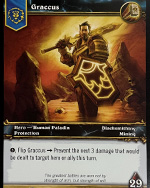
- Hero - The character you're playing as, and which the deck is built around. The hero determines what cards can go in the deck (Alliance or Horde allies, abilities based on the hero's class and professions and specializations and race, etc.). The hero also has a once-per-game power that can be used by flipping the hero over. Heros are available in both normal-sized cards and oversized cards.
- Ally - Cards representing other characters and creatures in WoW which will join your fight. Similar to creatures in Magic, they attack your opponent's allies (or hero), can defend for you, and may have powers. Each ally belongs to a faction (Alliance or Horde).
- Ability - Cards representing skills that the hero uses, with varying effects from dealing damage to healing to drawing cards and more.
- Equipment - Cards representing items that the hero equips or uses, from weapons and armor to other usable items. Weapons can naturally be used to attack, while armor can be used to defend against attacks.
- Quest - Cards representing goals in WoW. In the card game, they are a special kind of resource that can be used for some benefit (once their requirements are met) in addition to being used to play other cards.
- Location - Cards representing places in WoW. In the card game, they are a special kind of resource similar to quests, but which remain face-up when used.
- Token - Certain powers create "tokens" which are just a form of ally. Token cards were available for many types of these tokens, many of which were smaller-sized cards.
Sets and Decks

Upper Deck released 10 booster sets for the game, starting with Heroes of Azeroth in October 2006 and ending with Scourgewar in November 2009. There was also an Archives set of reprints released in August 2010. The game additionally had many smaller promotional sets and cards. The game was structured in three release "blocks", with Scourgewar being part of the fourth block (which was continued and completed by Cryptozoic).
The first two sets (Heroes of Azeroth, Through the Dark Portal), the fourth set (March of the Legion), and the seventh set (Drums of War) released starter decks. There was an additional starter deck product (Death Knight) that does not belong to any of the 10 sets, but was released before Scourgewar. In this manner, you can think of the first set in each block as having a corresponding starter deck product (with Dark Portal just being a bonus).
All sets (even the Death Knight starters, which are completely fixed) have common, uncommon, and rare cards. Other sets include epic and loot rarity cards. Oversized heroes, only available through starter decks, can be thought of as their own rarity as well.
One unique thing that WoW did was Raid Decks, a fixed product representing a big boss battle or dungeon that multiple heroes would cooperate to defeat. However, these included only cards for the raid boss and did not include player decks (ignoring products like Assault On Icecrown Citadel, which was a Cryptozoic product), so we are not covering them here. Loot cards are also fairly unique, being both normal, playable TCG cards, but each containing a scratch-off section that reveals a code that can be redeemed in the World of Warcraft MMORPG for various things (including exclusive mounts).
Deck Composition and Contents

Starter Decks
Decks: Blind Boxes
Players: One
Size: Reduced Legal Deck
Rarities: Common, Uncommon, Rare
Rulebook: Included
Playmat: Not Included
Other Items: 2 Booster Packs, Deck Box
The first three sets of starter decks (Heroes of Azeroth, Through the Dark Portal, March of the Legion) all had the same format. Each included a 32 card deck* (a legal deck is 60 cards) plus a matching (regular-sized) hero card, all randomly chosen from 9 possible decks per set. All decks were fixed, and a given hero's deck would always contain the same cards. The box does not indicate which hero (or deck) are within.
In addition, each deck would include three random oversized hero cards, randomly chosen from all of the heroes in a given set. This was not tied in any way to which deck was in the box. Each starter also included 2 booster packs from the set, and the box the cards came in was a UDE Deck Box, which was a really nice box that could store two decks (albeit very snugly, if they were sleeved) as well as the included rulebook (which itself was themed to the set).
*The Heroes of Azeroth boxes say they contain 31-card decks, while Dark Portal and Legion boxes say they contain 33-card decks. (These numbers clearly include the hero itself.) However, Azeroth decks are actually 32 cards plus the hero (consistent with the other two), so the Azeroth boxes are incorrect. (A full listing of the 9 Azeroth decks can be found on my website, which were compiled directly from sealed, unopened starter decks.)

PvP Battle Deck
Decks: All Same
Players: Two
Size: Reduced Legal Deck
Rarities: Common, Uncommon, Rare, Starter
Rulebook: Included
Playmat: Not Included
Other Items: UDE Points Card, Deck Box
The PvP Battle Deck was released with the Drums of War set and, as the name suggests, it is a starter deck intended for two players. All PvP Battle Decks contain the same two (fixed) decks within: an Alliance Mage deck with Spellweaver Jihan, and a Horde Hunter deck with The Longeye. Each deck is 43 cards (a legal deck is 60 cards) plus the hero, and decks across all PvP Battle Decks contain the same cards.
In addition, each product includes three random oversized hero cards, randomly chosen from all 18 heroes in the Drums of War set. Each starter also included a UDE Points Card, and came in a UDE Deck Box.
Each of the two decks includes 4 ally cards (3 or 4 copies of each) that are found only in the starters (marked as uncommon rarity, because Upper Deck is allergic to a starter-only rarity designation, even as the set and numbering for these cards is "Drums Starter X/8"). All other cards are common, uncommon (7 cards in one deck, 2 in another), or rare (2 cards per deck). Because WoW decks are so specific to the hero, and the heroes in these two decks were different factions and classes, it is not possible to combine the two decks into a fully legal 60-card deck.

Death Knight Deluxe Starter
Decks: Blind Boxes
Players: Two
Size: Reduced Legal Deck
Rarities: Common, Uncommon, Rare, Starter
Rulebook: Included
Playmat: Not Included
Other Items: Deck Box
The Deluxe Starter deck was (uniquely) not associated with any set, instead featuring 27 different cards that were exclusive to this deck. While each card has a rarity (common, uncommon, rare), all Death Knight decks are fixed and contain the same cards, so all such cards are effectively starter-only rarity. (Upper Deck is apparently allergic to a starter-only rarity designation.) The Death Knight deck is 32 cards, plus the hero, plus 3 Ghoul token cards that are not part of the deck.
The deck itself is a Horde Death Knight deck based around Saery Dusksorrow, but the box includes an additional 17-card pack that contains an Alliance Death Knight hero (Randolphe Mortimer), extra ability cards, Alliance allies, and some more equipment. In this manner, the deck can be converted from Horde to Alliance. As this deck was the introduction of the Death Knight class to the card game, it appropriately enables Death Knight usage for each faction.
The box also included a random Through the Dark Portal starter deck, with 32 cards, which allows two players to play the game with a single starter. As with the Dark Portal starters themselves, the decks are fixed and based around one of 9 possible heroes from that set.
The product does not include any oversized heroes (nor any booster packs, from any set), but it does come in the usual UDE Deck Box.
Deck Rarity Analysis
The first three starter sets are okay. Each deck contains one rare card and six uncommons, which isn't hugely spoilering booster pulls, especially given sets like Heroes of Azeroth contain 110 rares (and 22 epic rares) and 115 uncommon cards. (Each deck's rare card is not duplicated across the other decks in the set, thankfully.) However, because the decks are blind packed, if you buy a large number of starters, you're going to get duplicate rares, which does ruin the feeling of pulling those rares from boosters. This is made worse by the fact that booster packs contain 15 cards (higher than other games) with only one rare and three uncommons, making unique rares an even smaller percentage of overall cards you're opening. However, because every card in a starter deck can be pulled from a booster, there isn't a huge incentive (other than the oversized heroes) to purchase multiple starters. The fact that a starter includes 2 booster packs also makes starter deck purchase more appealing, if you were wanting to collect all the oversized hero cards. As far as card games go, this is fairly standard with fixed decks, and the oversized hero situation is fine thanks to the boosters.
Drums of War is... not great. Actually, it's nearly the worst starter product I've seen in any collectable card game, from a collector's standpoint. (The actual worst is Score's Dragon Ball Z TCG.) Every Drums of War starter contains exactly the same cards, save for the three random oversized heroes, and no booster packs... and therein lies the problem. If you want to collect a full set of 18 oversized heroes, you're buying a large number of starter decks (6 starters if you're trading, or far far more if you're not), and getting increasingly many copies of the four rare cards (a minimum of 6 of each, when a full playset is 4 copies). That completely spoils pulling these rares from Drums of War boosters. Given the sheer size of WoW expansion sets (Drums of War had 268 cards, with 78 uncommons, 72 rares, and 16 epic rares) and the larger booster packs (19 cards per pack, with 1 rare and 3 uncommons), you could actually argue that this is spoiling the uncommons too. I wish they would've included at least one booster pack in each box, so you at least have some benefit to continually pulling the same deck cards. Ideally, all cards in the decks would have been starter-only rarity.
In contrast, Death Knight starters are about as good as you can get. Thanks to the 17-card bonus pack ensuring you get at least 2 copies of each card in a box, you only need to purchase two starters to have a full playset of 4 of each of the cards. And the random Dark Portal deck is a nice bonus that (as noted above) doesn't spoil things too much. A+ recovery, and an excellent way to demonstrate how to do fixed starter decks right for collectors: By including exclusively starter-rarity cards.
Alan's Thoughts On The Game
WoW is one of my favorite card games. Thanks to me getting into it after it was defunct (and therefore getting starter decks for under $2/each) but after I had a full-time job (so I could spend hundreds of dollars on products), and because the first three starter products (which was the bulk of my purchases) included booster packs, I was able to build up a huge pool of starter decks and cards. I have significantly more WoW cards than .hack//ENEMY cards, and that's including the huge lot of cards I acquired from a friend for that game.
Which is nice from a collector's standpoint, but... the game itself is also fantastic, and there's a reason Hearthstone (arguably the most successful video card game) is built on its gameplay base. The fact that any card can be played as a resource (not just quests and locations) greatly mitigates the energy deck screw you can experience with other energy-in-deck games like Magic or Pokemon. The theming around a hero provides a really good feel to the game, and hero powers are not overpowered. The rules are relatively easy to learn, and the rulebook is extremely comprehensive. Gameplay itself is quick and dynamic, but also deeply strategic, and you feel like there are always things you can do to deal with a given game situation. The different classes feel pleasantly different. Raid decks add a really interesting multiplayer aspect to the game. The art is gorgeous.
All around, just a really enjoyable experience. And I don't (and never have) played the WoW video game.
I do find it odd that none of the starters are legal 60-card decks. They're not even half decks, instead being an awkward (but consistent) 32 cards for most of the starters. I suppose the size might be so there isn't excessive card duplication within a deck, but it honestly would be fine to provide four copies of useful abilities and allies within a deck if it meant that you wouldn't have to augment it with boosters to make it actually legal. (Yes, I know legal doesn't mean competitive, and perhaps doing it this way ensures you'll start with reduced decks against other starter decks to learn the game before building actually good decks to take on real players. But it still just feels like such an odd decision, especially given Cryptozoic's later yearly class starters were legal 60 card decks. FWIW, Cryptozoic also marked which deck you'd get on the starter deck boxes, fixing the blind pull issue too. For all their weird game changes, starter decks were certainly one of the better ones.)
However, my biggest issue with the game is entirely a me problem: I purchased over 200 starter decks (between the five starter products) as various wholesale sellers were liquidating their stock, getting each deck for under $2/each. The end result is hundreds of UDE deck boxes taking up space that seem too nice (and potentially useful) to throw away, but that are also too worthless to be donateable. They're also simultaneously slightly small to hold two sleeved decks, but too large for me to want to use to carry things around (compared to two standard deck boxes). But that's not going to be a problem anyone else will really have.
Resources
- wowcards.info (includes card listings with images)
- WoW Deckbuilder
- Starter Deck Card Lists (AlanvDotOrg Randomjunk)