 Publisher: AEG
Summary
Spycraft was a card game by AEG, based on the tabletop RPG of the same name. Players take control of a team of agents to complete various covert missions. The game was distributed in starter decks and booster packs (with either 11 or 15 cards). There were also promo cards available.
Card Types
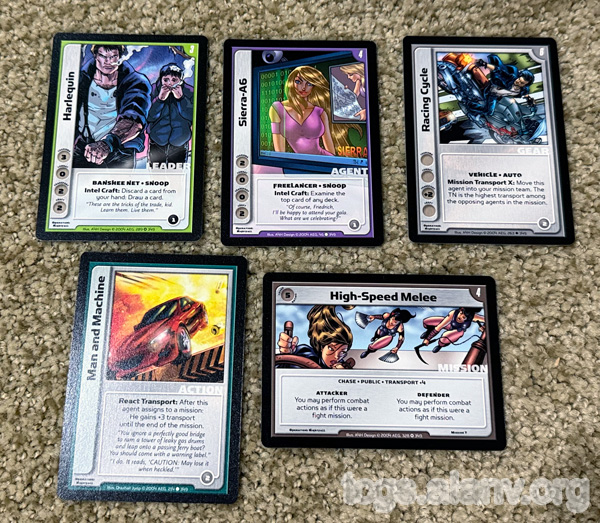
- Leader - Cards representing the most important people in your organization. Each has an expense (which they provide), some skills, an effect, and a level, and belong to a faction. They start the game in play, in a leader stack. Leaders are also considered agents.
- Agent - Cards representing operatives for your organization. Each has an expense (which they consume), some skills, bravado, and may have an effect. They may also belong to a faction (or be freelance).
- Action - Cards representing things you do to complete missions (or hurt oppoents). Each has an effect and bravado.
- Gear - Cards representing items and things that agents use on their missions. Each has an expense and bravado, and may adjust skill numbers or provide an effect.
- Mission - Cards representing various objectives to complete. Each has cover, victory points, and may have an effect.
Sets and Decks
The game saw a total of four sets released: Operation: Nightfall, Extinction Agenda, Day of the Bullet, and Murder Lottery. There were also promotional cards, additional mission cards, and cards exclusive to the two-player starter product (Shadow Academy). The first three sets (Operation: Nightfall, Extinction Agenda, Day of the Bullet) also had one-player starter decks available.
All sets included common, uncommon, and rare cards. Other than the base set (Operation: Nightfall), sets also included ultra rare cards.
Deck Composition and Contents
Shadow Academy
Decks: All Same
Players: Two
Size: Full Legal Decks
Rarities: Common, Uncommon, Rare, Starter
Rulebook: Included
Playmat: Not Included
Other Items: ??
I honestly don't know too much about this product, but it appears to come with a full set of 24 missions and a total of 110 other cards, which would form two legal decks (allowing for 4 leaders and a 51-card deck per side). There are 4 cards exclusive to this product, so we'll call them starter-only rarity, and assume the mix of rarities otherwise is consistent with the other starter decks.
Operation: Nightfall Starter Decks
Decks: Box Indicates Contents
Players: One
Size: Full Legal Deck
Rarities: Common, Uncommon, Rare, Starter
Rulebook: Included
Playmat: Not Included
Other Items: Reference Cards
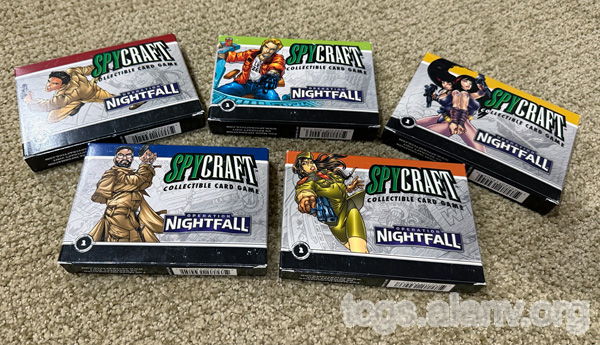
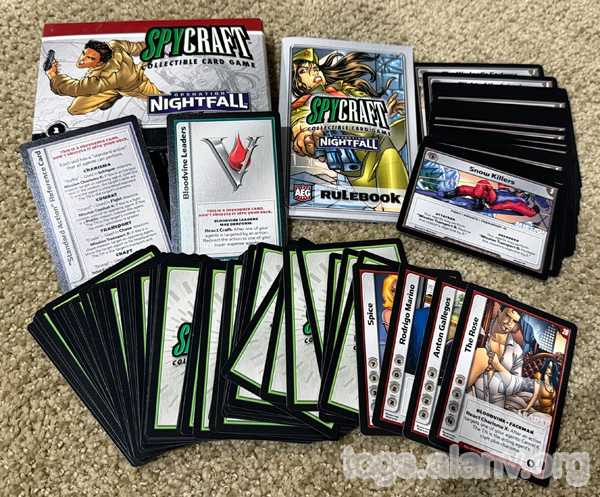
Five starter decks were available for the five factions: Banshee Net, Krypt, Bloodvine Syndicate, Shadow Patriots, and Nine Tiger. Each came with 84 cards consisting of 24 missions (the same across all decks), 4 leader cards matching the faction, and a 54-card deck.
Each also included a reference card for the faction and a general game reference card (counted in the box's "84 cards"), along with a full rulebook.
Starter deck contents were fixed, and the boxes indicated which deck you would get. The decks themselves are a mix of common, uncommon, rare, and starter-only cards: the 24 missions and 4 leaders are starter-only, and each 54-card deck includes one rare foil card, one starter-only card, one other rare card, and a mix of common and uncommon cards.
Other Starter Decks
Decks: Box Indicates Contents
Players: One
Size: Reduced Legal Deck
Rarities: Common, Uncommon, Rare, Starter
Rulebook: Included
Playmat: Not Included
Other Items: Reference Cards
The other starter decks were also each themed around a faction (Shadow Patriots, Bloodvine Syndicate, and Franchise for Extinction Agenda; Franchise, Krypt, Banshee Net, and Shadow Patriots for Day of the Bullet), and included 4 leaders from that faction, 6 new mission cards, and a 48-card deck. (A legal deck is 50 or more cards, plus 24 missions shared between players, plus 4 leaders.) Each deck also includes a rules sheet and two reference cards (counted in the box's "60 cards").
Starter deck contents were fixed, and the boxes indicated which deck you would get. The decks themselves are a mix of common, uncommon, rare, and starter-only cards: the 6 missions and 4 leaders are starter-only, and the remaining cards consist of one rare foil card, one other rare card, and and a mix of common, uncommon, and starter-only cards. (Some cards are reprints from previous sets.)
Deck Rarity Analysis
I haven't opened any booster packs, but under the assumption that the rare cards in starter decks can be found in booster packs, this is pretty normal. Each deck includes two (different) rares, and the decks clearly indicate the cards inside, so you're not spoiling rares too much. As decks are limited to 3 copies of a given card, and you're not probably not going to be buying multiples of each, this is fine.
Alan's Thoughts On The Game
We have to start with the inclusions in the Operation: Nightfall starter decks. This is fantastic; Including all 24 mission cards required to play the game (when the rules point out you can download them from the website at any point) plus reference cards is amazing. It means you're not going to have to remember as much during gameplay, because you have cards in front of you that remind you of standard actions and faction-specific abilities. The later starter decks are likewise nice, except they're two cards shy of a legal deck to make room for these reference cards, which is a somewhat questionable decision. But as far as TCGs go, I really like how comprehensive the starters are.
Gameplay-wise, I really enjoy this game. It has admittedly been a while since I've played it, but I remember it feeling very thematic, and playing surprisingly straightforwardly, with a relatively simple ruleset that's easy to learn. Playing cards face down is great, both because you can delay paying their costs but also because it fits the covert/surprise nature of the theme very well. I also feel like it does multiplayer well, which is interesting given I didn't like FMA's multiplayer pass-or-play mechanic with stat-based combat, and this actually feels very similar. (Maybe it was the group I was playing with for each game. Or maybe it's how this game makes missions attempts interleaved but also end your plays, forcing interesting decisions about when to attempt, rather than having a more rigid phase structure to rounds. Or maybe it's the way defending a mission is somewhat volunteer rather than being determined by the attacker. Or maybe a combination of all of these things, that just give this game a more cohesive feel.)
In any case, I need to play this game again, and see if it holds up to my fond memories of it. For now, I recommend this one.
Resources
- Starter Deck Card Lists (AlanvDotOrg Randomjunk)