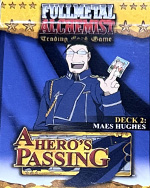
 Publisher: Joyride Entertainment
Summary
The Fullmetal Alchemist TCG (not to be confused with the Union Arena set) is a game by Joyride Entertainment, set in the world of (unsurprisingly) Fullmetal Alchemist. Play as a leader, recruit allies, and lead them on quests to find the Philosopher's Stone. The game was distributed in starter decks, preconstructed decks, and 11-card booster packs.
Unusually, the game has been designed for multiplayer, with the rules using a pass-or-play mechanic that explicitly supports an entire table of players, each with their own deck.
Card Types
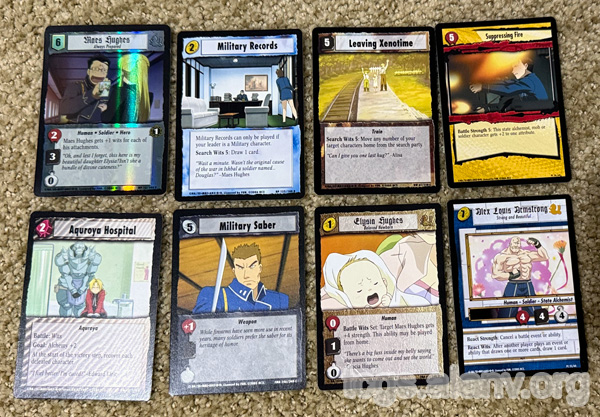
- Leader - Cards representing a character leading the quest to find the stone. Each has a level, a command rating, and the three stats (strength, wits, and alchemy), and may also have a faction and ability. You start the game with a stack of them (similar to the DBZ CCG).
- Ally - Cards representing characters following you on your quest. Each has a cost, the three stats (strength, wits, and alchemy), and have also have a faction and ability.
- Location - Cards representing places where you search. Each has a point value, battle type, battle goal, and may have an effect.
- Advantage - Cards representing beneficial items or occurrences. Each has a cost and an ability.
- Attachment - Cards representing items that characters can hold or equip. Each has a cost, may boost one of the three stats, and may have an ability.
- Event - Cards representing temporary occurrences that affect the game in various ways. Each has a cost and an ability.
Note that some cards will randomly have alternate templates. For example, the two top right cards are both events, and the two bottom right cards are both allies. (This is not based on the set nor which faction a card belongs to; cards within a set can have different templates, even within a faction.)
Sets and Decks
The game saw a total of seven sets released: Premier, Blood & Water, Artificial Human, A Hero's Passing, Alchemist's Gate, Seven Deadly Sins, and Sacrifice. An eighth set (Conqueror of Shamballa) was teased but never released. There were also various promotional cards.
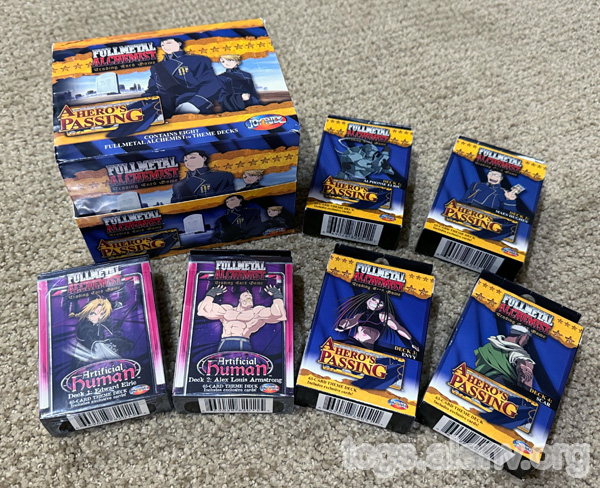
The Premiere set had starter decks. The next three sets (Blood & Water, Artificial Human, and A Hero's Passing) had theme decks, with A Hero's Passing having a slightly different composition.
All sets include extra-rare cards, which can include signed cards (much like the Bleach TCG), foil cards, or translucent cards (like the DBZ TCG).
Deck Composition and Contents
Starter Decks
Decks: Box Indicates Contents
Players: One
Size: Reduced Legal Deck
Rarities: Common, Uncommon, Rare, Starter
Rulebook: Included
Playmat: Not Included
Other Items: None
Five starter decks were available (Edward Elric, Alphonse Elric, Roy Mustang, Father Cornello, and Lust) for the Premier set. Starter decks contained 50 cards, the decks were fixed, and the boxes indicated which deck you would get.
The exact contents of a deck are unclear (as I never owned starters, myself), but as far as I can tell from this unboxing video, a deck includes 10 random cards (one foil and one rare) in addition to the playable deck. One leader card is starter-only rarity. Each deck therefore included a leader with 2 stages, 5 locations, 33 deck cards, and 10 extra cards. (A legal deck is 9 locations and 60 or more deck cards.)
These were also the only decks to include a rulebook.

Blood & Water and Artificial Human Theme Decks
Decks: Box Indicates Contents
Players: One
Size: Reduced Legal Deck
Rarities: Common, Uncommon, Starter
Rulebook: Not Included
Playmat: Not Included
Other Items: Rules Update Sheet
The two sets had two different theme decks each (Scar and Roy Mustang for Blood & Water, Edward Elric and Alex Louis Armstrong for Artificial Human). Each deck had 65 cards: a leader with 2 stages, 5 locations and 58 other deck cards. (A legal deck is 9 locations and 60 or more deck cards.)
Preconstructed deck contents were fixed, and the boxes indicated which deck you would get. The decks themselves are a mix of common, uncommon, and starter-only cards, including cards from other sets. The 3 starter-only cards are foiled (your two leader cards and one other card).
These theme decks do not include a rulebook, although they do include a rules update sheet.
A Hero's Passing Theme Decks
Decks: Box Indicates Contents
Players: One
Size: Reduced Legal Deck
Rarities: Common, Uncommon, Rare, Starter
Rulebook: Not Included
Playmat: Not Included
Other Items: Rules Update Sheet
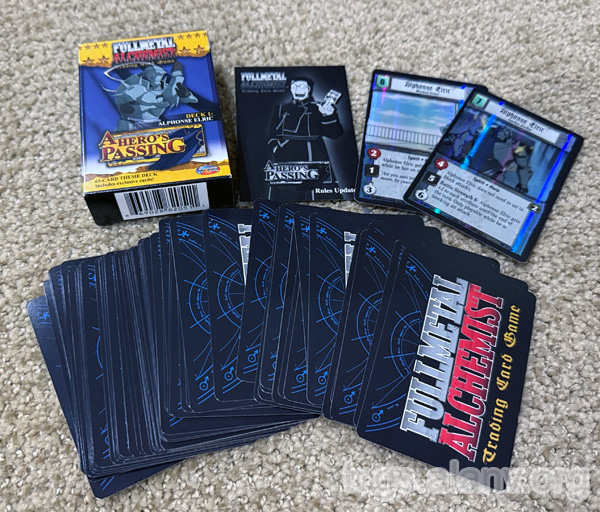
There were 4 different theme decks available: Alphonse Elric, Maes Hughes, Envy, and Scar. Each deck had 63 cards: a leader with 2 stages, 5 locations and 56 other deck cards. (A legal deck is 9 locations and 60 or more deck cards.)
Preconstructed deck contents were fixed, and the boxes indicated which deck you would get. The decks themselves are a mix of common, uncommon, rare, and starter-only cards, including cards from other sets. The 3 starter-only cards are foiled (your two leader cards and one other card). Each deck includes 2-3 rare cards.
These theme decks do not include a rulebook, although they do include a rules update sheet.
Deck Rarity Analysis
For everything but A Hero's Passing theme decks, good. Assuming I have the analysis of Premier starter decks correct, the random rare does not spoil boosters, and none of the theme decks have rare cards so we're good there. The fact that each theme deck indicates (on the box) which deck you're getting also makes it easy to collect all the starter-only cards.
Since the theme decks for A Hero's Passing seem to only include rare cards from other sets, this technically doesn't spoil its boosters either, so I'll give this a pass.
The only complaint is how much decks seem to include the same cards, even across sets. But since they're all common and uncommon, it's not a huge deal, and you can actually consider it kind of a bonus if you start with a set and get some cards from earlier sets.
Alan's Thoughts On The Game
This game came out while I was in undergrad, and my friend group was watching through the FMA anime. I wanted to try and get the group playing an actual active TCG (after getting them into .hack//ENEMY and making an attempt at Gundam War), but that never really happened, partially because actually-active games are expensive to play (at least on an undergrad's budget). Years later, when I had a job, I picked up some boxes of theme decks, and therefore got to play the game for the first time with my usual board gaming group.
And I was disappointed.
First, the game seems like it attempts to have some rubber banding by having the "least" active player (lowest wits stat total) go first in searching but the "most" active player go first in other phases, but because everything goes around the table anyway, this can be largely ineffectual. If the least active player is seated to the most active player's right, the most active player is going second in searching. If the most active player is seated to the least active player's right, the least active player is going second in playing cards. This activeness also becomes annoying to track as allies are played, changing the totals between phases. I would have greatly preferred a system that just rotates the active player, as the current mechanism adds a lot of play complexity for very little benefit. Or they should fully lean into the mechanic and rank players from most to least at the start of each round, and go in that order.
Second, the pass-or-play mechanic makes sense from the standpoint of making this a 3+ player game, but it also means you're loading a bunch of plays into your head and then either having those plans foiled (by other players' plays or abilities or effects) or just slowing executing that process over multiple times around the table. This is particularly bad during the search phase, when your queued up event/ability plays will get sidelined for a battle. You can argue that this is part of the point of the design of the game, but I feel like it gets frustrating in practice in larger games.
Third, the mechanism for actually playing cards wants to be bounded by your leader and allies which are receiving the benefits, but it feels somewhat inconsistent. Attachments, particularly, have no real limit (especially on higher-cost allies) because you just have to meet the cost requirement rather than spending anything, and your leader's command feels like a weird resource that is both spent (for allies) and not (for attachments). And then there's costs for using abilities that may be free or may be paid in discards (equivalent exchange) depending on the target. In general, it just feels like the game has too many different costing mechanisms (some of which can use equivalent exchange and some of which can't)... they may make thematic sense, but it doesn't feel good from a gameplay standpoint.
Battles themselves also feel weirdly constrained given the rest of the game is designed explicitly for 3+ players, as they only involve two players fighting at a time. Yes, other players can play events and use abilities to affect the battle, but this just feels like it slows down a 2-player battle even more, unless you're in the unusual position of wanting one side to win. It also allows king making (particularly in a 3 player game) since both sides defeat characters, leaving the other non-battling players unscathed. Winning a battle also doesn't seem to have any direct impact (since both the attacker and defender will defeat characters afterward, which also seems to be based on just the characters' stats??), which is really weird. I really wish they had gone with some mechanism that would allow multiple players to simultaneously engage in battle.
(Interestingly, a lot of these mechanics such as pass-or-play and combat are very similar to the Spycraft CCG, which I reacted positively to. I think maybe this game has a more complicated ruleset with more phases in a turn, making the above issues become problems, compared to Spycraft's single "phase". Or it could be the people I played each game with.)
Also, the card backs are horizontal. This doesn't affect gameplay, but I'm still annoyed by it, since none of the cards are horizontally-oriented. The card titles are also in a font that is extremely difficult to read, especially quickly at a glance, which does sometimes affect gameplay. As mentioned, some cards randomly have alternate templates, which wouldn't be as big a deal if the cards said what type they were on them (and the way you actually tell cards apart, given the lack of a type indicator, is a combination of their icon on the top left and the card background color), so that's also a bizarre and gameplay-impacting choice. The faction icons can also have different appearances, which makes them harder to distinguish at first glance, and that has direct gameplay impact (in the form of additional cost to recruit). Really questionable graphic design decisions, all around.
It's certainly not a bad game, and it does attempt to do a lot of unique things (which I do appreciate, given the swath of Magic-like TCGs out there), but it just doesn't really feel fun to play.
It's a pass for me.
Side note: I also hate games that don't include some form of rulebook in deck boxes. Decipher included a rulebook in all of their card games, packaged into similar sized boxes to this one, with the exception of the .hack//ENEMY Isolation theme decks (which I wish they hadn't done). Why can't you include that here? The boxes even (semi-insultingly) tell you to buy a Premier starter deck to get a rulebook. The decision to make theme decks 6-8 cards short of a legal deck (4 locations and 2-4 more deck cards) is also a frustrating one. So they made some weird product choices, too.
Resources
- FMA TCG on Anime Cubed
- Starter Deck Card Lists (AlanvDotOrg Randomjunk)