 Publisher: Decipher
Summary
The Star Trek Customizable Card Game (CCG) was a card game by Decipher set in the Star Trek universe. In the game, you play cards representing people, places, ships, and things in Star Trek, and take them on wild space adventures. The goal is to load up your ship with personnel, travel to various planets and space locations, and complete missions there. A mission will have impediments in the form of dilemmas, and your opponent can play other cards to thwart your progress.
(The game is usually referred to as First Edition (1E) because Decipher released a Second Edition (2E) of the Star Trek CCG in 2002. 2E is covered separately, but it is much more of a game than an experience. See my thoughts section on both pages for more. We're also ignoring the original game's name, Star Trek: The Next Generation Customizable Card Game.)
As one of the "first" card games, the game was distributed in a very large number of different products over its 12 year (!) lifespan, including starter decks (of all sorts of types) and booster packs (with 9, 11, or 15 cards, depending on the set), but also tournament packs, promotional packs, anthology collections, collector tins, and special sets.
The game also has a couple spinoffs: the Second Edition of course, but also the Tribbles Customizable Card Game (which actually works as a fun fixed-deck board game with its starter set). 1E also technically is still supported by the Continuing Committee, who releases new "virtual" card sets a few times a year and continues to maintain banlists and update the rules. We're not counting virtual sets, so for purposes of this writeup, the game is defunct.
*The final full set of 1E (The Motion Pictures) released in 2002, and the final anthology set (All Good Things) was released in 2003, but a special Enterprise Collection pack (to enable the Starfleet affilitation in 1E) was released in 2006, so that's the year we're using. We're also ignoring any 1E-compatible cards in 2E for purposes of the game release dates.

Card Types

The game has become somewhat infamous for having ~20 card types (depending how you count them). This list is presented in order of how much you should care about them. The game originally had 9 card types.
- Mission - Cards representing a location on the game's spaceline, either a planet or a location in space where something happens. Players are attempting to complete these missions to earn points and win the game. One of the 9 original card types.
- Dilemma - Cards representing a "roadblock" on the way to completing a mission. These were placed face-down under missions on the spaceline, and had to be completed by players before they could attempt a mission. Split into planet, space, and dual dilemmas. One of the 9 original card types. "Dual" dilemmas (two dilemmas on one card) also exist.
- Facility - Originally "outposts" (which later became a type of facility), cards representing a building (or space station). Other cards are played here, so these act as a "base" of sorts in the game. Facilities can be an Outpost, Headquarters, or Station. One of the 9 original card types.
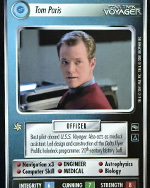
- Personnel - Cards representing beings in Star Trek, from various species (human, vulcan, etc.) and affilitations (Federation, Kingon, Hirogen, etc.). These cards contribute skills and stats toward solving dilemmas and missions. Dual personnel (two people on one card) were later introduced. One of the 9 original card types.
- Ship - Cards representing vessels in Star Trek, for the various affilitations. Used to move personnel around the spaceline to missions to solve them. One of the 9 original card types.
- Event - Cards representing major occurrences in Star Trek, with various effects on gameplay. One of the 9 original card types.
- Interrupt - Like events, but can be played during any player's turn as a reaction to playing other cards. One of the 9 original card types.
- Equipment - Cards representing objects that can be carried around (by personnel or on ships) or left on planets. Typically increases personnel stats or skills, but may have various effects. One of the 9 original card types.
- Doorway - Cards representing some sort of opening, either in space (such as a rift) or simply a door (like the captain's ready room door). These often start the game in play, and have ongoing effects like enabling certain types of personnel to be played or opening a side deck for play. Basically just a fancy event. These were added in the first expansion set (Alternate Universe).
- Objective - Cards representing various goals. Typically used with the borg affilitation, they typically score points (although later sets started using the type more loosely to where they're basically just like events).
- Incident - Cards representing events, but are not events for gameplay reasons (the textbox on event cards is too small, and they would be subject to effects that interact with event cards).
- Artifact - Cards representing rare objects in the game. These are placed face-down under missions on the spaceline, and are claimed when the mission is completed. Have various effects. One of the 9 original card types.
- Site - A location within a facility that enables personnel to move around within that facility, with various effects.
- Time Location - A location at a different point in time from the canon timeline of the card game. Personnel can use time travel to move to and from them.
- Tactic - A card representing some form of combat maneuver in ship battles. These are stored in a side deck and are used during combat, replacing the usual damage mechanic.
- Q Dilemma - A type of dilemma that stocks in your Q side deck, and plays from there. Primarily from the second expansion (Q Continuum).
- Q Event - A type of event that stocks in your Q side deck, and plays from there, but really is just a dilemma. Primarily from the second expansion (Q Continuum).
- Q Interrupt - A type of interrupt that stocks in your Q side deck, and plays from there, but really is just a dilemma. Primarily from the second expansion (Q Continuum).
- Tribble - A card representing some quantity of tribbles, from 1 to 100,000. Placed in a side deck, and the smaller ones can be carried by personnel as equipment. Also part of a spin-off game (the Tribbles Customizable Card Game). From the Trouble With Tribbles expansion.
- Trouble - A card representing some issue caused by tribbles. Placed in a side deck and are used to hinder your opponent. From the Trouble With Tribbles expansion.
Sets and Decks
There are many different ways to count the number of sets in this game, but if you go by how the Continuing Committee divides it up, the game had 35 sets, some of which were as small as one card, with the largest being the "base set" Premiere (of which there are 4 versions) with 363 cards. If you go by sets with actual non-fixed packs (and combine the four flavors of Premiere, which all have the same cards), the game had 14 sets plus a collected reprint set (Reflections), plus a ton of different promotional cards and sets.
Starter decks (in some form) were available for four of the sets: Premiere, Deep Space Nine, Voyager, and Trouble With Tribbles. Tournament "decks" (a set of booster packs plus a few cards to facilitate gameplay) were also available (which we won't cover here).
One other interesting thing is that, over its lifetime, the game played with all sorts of different rarities, and also distinguished "black border" (limited run) cards from "white border", especially for the Premiere set. Rarities ranged from the basic common/uncommon/rare/ultra rare to rare* (replaces an uncommon as a second rare in a pack), rare+ (rarer than rare), and dual-affiliation cards which each had two variants that together were as rare as the specified rarity (but individually were twice as rare). Starter-only and promo rarities also existed. For cards before the Trouble With Tribbles set, no collector information (card number or rarity) is printed on the card (and cards in the first three sets don't even have an expansion symbol), making the game somewhat more challenging for collectors.
Deck Composition and Contents
(Original) Premiere Starter Deck
Decks: Blind Boxes
Players: One
Size: Unplayable (Potentially Non-Legal) Deck
Rarities: Common, Uncommon, Rare
Rulebook: Included
Playmat: Not Included
Other Items: None
The original starter decks actually served as a decent way to collect a lot of different cards, as long as you didn't care about rares, as they included two random rares, 13 uncommons, and 45 commons. The cards were entirely random, meaning the deck was almost certainly going to be unplayable, as you would not be guaranteed to have enough missions, your personnel would be a mix of affilitations (which cannot mix by default), and (given the relative weakness of common and uncommon personnel in the premiere set) your cards would likely be unable to complete the missions you draw.
In addition to the cards, the deck includes a rulebook.
The rules have changed a lot over the game's 12-year lifespan, so the deck was technically legal according to the initial rules, but has a small chance of being illegal according to modern rules (requiring at least 30 cards in your main deck and at most 30 cards in your seed deck). Still, this is not a deck you get to play the game; it's a deck you get to start your collection to build a deck to play the game.
Worth noting: A "Warp Pack" was later released to try and remedy some of this and attempt to make a starter deck playable, by providing several mission cards and a neutral outpost that could be used by any affiliation.
Starter Deck II
Decks: Blind Boxes
Players: One
Size: Playable** (Potentially Non-Legal) Deck
Rarities: Common, Uncommon, Rare
Rulebook: Included
Playmat: Not Included
Other Items: None
Starter Deck II was an attempt at making the game actually playable out of the box, via the inclusion of 8 fixed cards that are the same across every deck, including missions, a facility, and an event. ** The event (Memory Wipe) facilitates affilitation mixing for your opponent, meaning two Starter Deck IIs are playable against each other, but a Starter Deck II would not be playable against anyone bringing a customized deck without that card.
Beyond those 8 fixed cards, the deck itself includes 60 fully randomized cards with the same distribution as the original starters (two rares, 13 uncommons, and 45 commons), and an updated rulebook.
This deck runs the same small risk of being illegal as the original starter decks, as you could potentially have more than 30 (missions and dilemmas) included.
Deep Space Nine
Decks: Blind Boxes
Players: One
Size: Full Legal Deck
Rarities: Common, Uncommon, Rare, Starter
Rulebook: Included
Playmat: Not Included
Other Items: None
More of the same. The third starter deck includes 60 random cards, and the set has starter-only cards. Unfortunately, I do not have any of these to check their contents (or the promotional literature's claim that the starters are playable), so the exact contents and rarity mix are lost to time.
Introductory Two-Player Game
Decks: Box Indicates Contents
Players: Two
Size: Full Legal Deck
Rarities: Common, Starter
Rulebook: Included
Playmat: Not Included
Other Items: 2 Booster Packs, Information Sheet, Collector's List
A product with fixed decks, for two players. Two versions were available (Federation and Klingon). Both versions have the same two 60-card decks (Federation and Klingon), plus two additional promo cards that are the same between versions. The versions then have three additional promo cards that are the same for all copies of that version. (For example, all Federation games contained Admiral Picard, Commander Troi, and Commander Data.) The decks themselves contain only common cards plus starter-only missions.
The included boosters are one premiere pack and one Alternate Universe pack.

Trouble With Tribbles
Decks: Box Indicates Contents
Players: One
Size: Full Legal Deck, Reduced Legal Deck
Rarities: Common, Uncommon, Starter**
Rulebook: Included
Playmat: Not Included
Other Items: None
This set introduced two preconstructed starter decks (Federation and Klingon), with the box indicating which deck you were purchasing. Each deck includes 60 cards, but rarity here is a bit of a strange thing: **Each deck includes one card only found in that deck, while the other 59 cards are either reprints of already-released cards or common/uncommon cards from the Trouble With Tribbles expansion. Many of the reprinted cards (27 different cards across both decks) had tribbles added to the card images, and all reprinted were reprinted with updated copyright dates. As such, while the box claims the decks include "2 rare cards", it could be said that all cards are either starter-only rarity (the reprints) or common or uncommon (the Trouble With Tribbles cards).
However, if we take the original printings into account, and ignore the tribble-ation of the cards, four cards across the two decks (Chula: The Abyss from Blaze of Glory, Primitive Culture from First Contact, Morka from Deep Space Nine, and Alyssa Ogawa from First Contact) were originally released as rare cards (and all were tribble-i-fied for these starters). I leave it up to you to decide whether that makes them rare cards, rather than starter-only cards as I have them here.
From a game-legality standpoint, the Klingon version of the deck includes Tribble and Trouble cards (for a Tribble side deck; in addition to seed cards) in its 60 cards, leaving only 27 cards in the deck, which is shy of the 30 card requirement for a deck. That makes it technically illegal, although it is perfectly playable against the corresponding Federation deck (or other Klingon decks). The Federation deck includes 34 cards in its deck, making it fully legal for general play.
Each starter deck includes an updated rulebook.
Voyager
Decks: Blind
Players: One
Size: Full Legal (Warp Speed Format) Deck
Rarities: Common, Uncommon, Rare, Starter
Rulebook: Included
Playmat: Not Included
Other Items: None
Voyager starter decks were special, as they serve both as a starter deck for 1E, but also as a sealed product to facilitate new "Warp Speed" tournament play. Warp Speed is a format for the game that greatly simplifies the rules for the games (particularly around affiliations and setting up the spaceline) but which is played with a smaller deck and is limited to cards with the Voyager logo.
These decks included 40 semi-randomized cards, including two rares and a non-fixed number of commons and uncommons (ranging from 4 to 8) and 8 or 9 starter rarity cards. Every deck includes an outpost (Nekrit Supply Depot, which works for all affiliations). The decks were randomized but were always centered around an affiliation (Federation, Vidiian, or Kazon), making play reasonable. The cards were also semi-randomly selected to allow building of a deck that obeyed the Warp Speed deck rules (at most 10 seed cards and at least 20 deck cards).
In addition to the cards, each deck includes a rulebook covering Warp Speed play.
Deck Rarity Analysis
The decks here fall into two camps: Effectively fully random (especially as far as rares are concerned, which appear to be fully random even in the Voyager starter decks, to the extent that the set's Ultra Rare can be found in the starters) or fully fixed (for the two Trouble With Tribbles decks). But we'll split off the semi-random starters because there's interesting impact on non-rare cards from them.
For the fully random decks, the randomness is (of course) perfect. Pulling a given rare from a starter deck is just as exciting as pulling it from a booster pack, and you can pull any rare from any starter or booster. The fixed starter only cards in Starter Deck II are a pleasant bonus, and buying 4 starters (if you wanted a complete playset of the event, for some reason) hurts far less when you're getting 8 random rares and a bunch of other random cards at the same time.
The semi-random starters are interesting because the card pool they select from apparently is not the entire Voyager expansion. This forum post explains that there's a sequence of (common and uncommon) cards, and the deck pulls a run of 32 cards from the sequence (plus 2 random rare/ultra rare cards, and 6 random commons). (FWIW this sequencing of cards is very similar to how Decipher creates Lord of the Rings CCG Draft packs.) As such, while you can get any common and any rare, you cannot get every uncommon through a starter, making certain uncommons rarer (in some sense) than rares for players who buy primarily starter decks. The sequence also means that common cards that are not in the sequence are rarer (overall) for players who buy primarily starters. From a card rarity standpoint, this is weird, but it doesn't in any way ruin the feeling of pulling a specific rare you wanted, as those remain truly random, so I'll give it a pass. The distribution of starter-only cards is also reasonable; in a box of 12 starters, I pulled at least one copy of each starter-only rarity card. (Whether DS9 starters work the same way or not is a question no one seems to know the answer to.)
The Trouble With Tribbles decks, though, are a much more difficult question. The four "rare" cards between the two decks are tribble-i-fied, effectively making them new (and starter-only) cards, and they are from older sets anyway, so you're not ruining the payoff from pulling "new" rares from Trouble With Tribble boosters. Additionally, the starters also include reprints of starter-only cards (from the Deep Space Nine set), so there's some value there. That's good enough for me to say that this isn't a problem: you don't need to buy multiple starters to get all the starter-only cards, and you're not spoiling rares from booster pulls. Additionally, the decks themselves basically don't duplicate cards (with the exception of tribbles, troubles, and a ship and a weapon in the Klingon deck, of which there are a mere 2 copies of each), making them an excellent value at just getting different cards.
(As the two-player starter contains only common and promo cards, it kinda doesn't contribute to the deck rarity analysis, although having to buy a second set for the sake of three cards is unideal.)
For general analyses of card distributions and rarities in 1E products, this forum post is an excellent resource.
Alan's Thoughts On The Game
I feel like the (lack of) photos on this page doesn't do justice for how much of an impact this game had on my life (and now my obsession with defunct card games). 1E was the second card game that I purchased and played (after Pokemon, in middle school). I remember going to card shops and seeing the enhanced First Contact products newly on the shelves. I remember buying packs of Alternate Universe and anthology collections from card shops. I remember my first ever bulk sealed product purchase (in college) being 5 boxes of 1E (Voyager starters, Voyager boosters, Holodeck Adventures boosters, The Borg boosters, and The Motion Pictures boosters). I remember the joy of opening personnel I knew from the shows and wanting to put them into a deck. I remember sitting with my best-friend-at-the-time at a sleepover going through our cards and building decks and playing together. But maybe because I got into this game so long ago (well before it went defunct), I also don't have most of the packaging anymore: No DS9 or Voyager starter deck boxes, no booster packs or boxes, and very little in terms of actual sealed product to photograph. The photos above are cheaper sealed product I purchased much more recently, well after the game went under, mostly for nostalgia purposes. (The bulk of my collection is in three very large binders.) To this day, 1E remains one of only three games I have ever purchased in a game store (rather than as part of a bulk sealed product purchase).
All of which is to say... I have a lot of love for this game. I loved playing this game. But I also recognize how flawed it is as a game.
1E came out at a time when TCGs (or CCGs, as Decipher would call their games) were a new thing. Magic had just come out a year before (1993) and Pokemon wouldn't become a thing for another few years yet (1999, at least in the US). They were going down an unpaved path, and I would say the first few sets of 1E (or just STCCG) were focused much more on creating an experience than being a good card game. It was excellent at letting you pretend to be in charge of a Federation fleet off to engage the Klingons in battle, or controlling Romulans as they took control of a planet. So many things in this game are much more appropriate for a game that's trying to be true-to-a-fault to its source material, rather than a game that's trying to be a game. For example: The sheer number of combat rules (Federation can never initiate battle, Romulans cannot attack other Romulans, Klingons can attack whoever, and you must have OFFICER or Leadership to initiate personnel battle) and special icons (holographic personnel can only exist where a holodeck or holo-emitter is in play, cards representing things from an alternate reality have to come through an "alternate universe" doorway), the way that "side personnel" (extras on the shows) are often relatively useless, the division of the spaceline into quadrants that you can't freely travel between, and the existence of time locations that you have to time travel (a mechanic that exists only on cards) to. The current 40-page basic rules document starts with "Allow a couple hours to read the rules", and there's a 63-page rules suppliment. Enough said.
Actually, not enough said; let's use an example. The Borg have the ability to target The Phoenix (a ship card) at the Montana Missile Complex (a time location) with an objective (Stop First Contact) that, if successful, has the outcome of removing all human and Federation-affiliation cards from the game (from anywhere, including all draw decks and side decks and discard piles and hands; an effect which, by the way, is written only in the rules and not on any cards). To stop it, you need to be able to time travel (via cards) to the time location and defeat The Borg in battle. Thematic? Heck yeah; you get to re-create the First Contact movie! Balanced? Hell no. Well, maybe it's balanced, but it'd require you understand cards from the multi-thousand card pool, and know what you need to put in your deck (or side decks) to handle that case if it comes up, which at the very least makes the game utterly inaccessible to newcomers. And it's only one of many, many hugely game-impactful cards and effects that are hyper-specific to Star Trek films or episodes. (Another more immediate example is that the entire Starfleet affiliation is time-displaced and has to time travel their cards from a time location onto the primary spaceline. Extremely thematic, but utterly intimidating as a game mechanic.)
Which is to say, all of this made it much much less good at being a remotely accessible game, or even a balanced one. In the first several sets, attempts were made to fix the problem of one play per turn (Red Alert), fix the fix (Yellow Alert), and just generally make the game play faster without breaking it. Non-rare personnel (anyone not in the main cast of TNG, really) were not much more than cannon (or dilemma) fodder with their extremely limited skills. Even just the makeup of starter decks (with fully random cards, which followed Magic's 60-card random starter decks with 2 rare cards) was more appropriate for casual people looking to collect cards rather than players looking for a jumping point into a serious game.
The game did eventually find its footing (probably around the First Contact set, but that was also when The Borg with its ridiculous supplimental rules were introduced, increasing the barrier to entry even further), but it was also around the point where I was no longer really looking to play the game. I never played 1E in a playgroup (unlike Pokemon), and really just started buying cards to collect (and put in a binder), so it's hard for me to say how it evolved after that point. But the sheer number of card types that continued being introduced (such as incidents, which were just events under a different name) seem like a good indication that the game was trying to build a serious experience on top of a very shaky base ruleset.
I don't fault it for that, of course. And I know a lot of people (even today, thanks to the Continuing Committee) continue to play 1E as a serious competitive game. But for me, that wasn't ever (and wouldn't ever be) the point. I'm a gamer first and a roleplayer second (or actually tenth, or hundreth, or something like that). If I wanted an actual Star Trek gameplay experience, I'd play 2E. If I wanted to buy cards and put them in a binder and look lovingly over them, then it's 1E for me all the way.
And maybe that's good enough.
Resources
- The Continuing Committee (maintains and continues to release cards for the game)
- Starter Deck Card Lists (AlanvDotOrg Randomjunk)