 Publisher: Decipher
Summary
Similar to the First Edition (1E) of the Star Trek Customization Card Game, the Second Edition (2E) of the game was a card game by Decipher set in the Star Trek universe. In the game, you play cards representing people, places, ships, and things in Star Trek, and take them on wild space adventures. The goal is to load up your ship with personnel, travel to various planets and space locations, and complete missions there. A mission will have impediments in the form of dilemmas, and your opponent can play other cards to thwart your progress.
Just like 1E, 2E was available in starter decks, 11-card booster packs, anthology sets, and several promotional sets.
(This version of the game is represents a much more game-focused game, rather than trying to deliver an experience like 1E. See my thoughts section on both pages for more.)
2E is technically still supported by the Continuing Committee, who releases new "virtual" card sets a few times a year and continues to maintain banlists and update the rules. We're not counting virtual sets, so for purposes of this writeup, the game is defunct.

Card Types

In contrast to 1E's ~20 card types, 2E has only 7.
- Mission - Cards representing a location on the game's spaceline, either a planet or a location in space where something happens. Players are attempting to complete these missions to earn points and win the game. Some missions are Headquarters, which represent an affiliation's homeworld or base of operations, and allow ships and personnel to be played there, and are not "attemptable" for points.
- Dilemma - Cards representing a "roadblock" on the way to completing a mission. These are drawn from a side deck and played during an opponent's mission attempt to try and thwart it. Can be either space, planet, or both (space and planet) type.
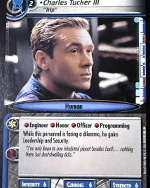
- Personnel - Cards representing beings in Star Trek, from various species (human, vulcan, etc.) and affilitations (Federation, Kingon, Hirogen, etc.). These cards contribute skills and stats toward solving dilemmas and missions.
- Ship - Cards representing vessels in Star Trek, for the various affilitations. Used to move personnel around the spaceline to missions to solve them.
- Event - Cards representing major occurrences in Star Trek, with various effects on gameplay.
- Interrupt - Like events, but can be played during any player's turn as a reaction to playing other cards.
- Equipment - Cards representing objects that can be carried around (by personnel or on ships) or left on planets. Typically increases personnel stats or skills, but may have various effects.
Sets and Decks
There are many different ways to count the number of sets in this game, but if you go by how the Continuing Committee divides it up, the game had 18 sets, some of which were as small as 18 cards, with the largest being the "base set" Second Edition with 415 cards. If you go by sets with actual non-fixed packs, the game had 10 sets plus a collected reprint set (Reflections 2.0), plus a ton of different promotional cards and sets.
Starter decks were available for two of the sets: Second Edition and Call To Arms. Tournament "decks" (a set of booster packs plus a few cards to facilitate gameplay) were also available (which we won't cover here). Worth noting is that you were able to purchase a "combo box" for the two sets that contained 8 starter decks and 24 booster packs, which was an excellent idea.
The game is also somewhat noteworthy for its "archive" foil cards that were randomly inserted (some were "archive portrait" featuring larger images and smaller textboxes), acting both as preview cards for upcoming sets, and as incentive for players (as they often featured attractive female characters). This was in addition to the standard common/uncommon/rare, starter-only, and promo rarities.
One other noteworthy thing is that many cards were backward compatible with 1E. This included some promotional sets, where all cards in the set were backward compatible. However, that translation of cards was not necessarily straightforward, with its own multi-page rulebook to do the conversions of skills and attributes over. (The fact that this conversion was so complicated itself feels very 1E-y, so it's appropriate.)
Deck Composition and Contents

Starter Deck
Decks: Box Indicates Contents
Players: One
Size: Full Legal Deck
Rarities: Common, Starter
Rulebook: Included
Playmat: Not Included
Other Items: None
There are six starter decks available from two sets (Second Edition and Call To Arms): TNG, DS9, Klingon, Romulan, Borg, and Dominion. All six decks are a fully-legal 60 card deck.
Starter decks were fixed, and the boxes indicated which deck you would get. The decks themselves are a mix of common and starter-only rarity cards (harking back to the Two-Player starters from 1E, where there were no uncommons in the decks). None of the starter deck cards are foiled.
Each box also included three random rare cards, along with a rulebook.
Deck Rarity Analysis
There's nothing to complain about here. All starter decks contain 3 random rares from the set, and contain only common cards in the fixed decks, so rares and even uncommons retain their value from booster packs. Additionally, you can reliably obtain at least one copy (and, for some cards, 12 copies) of each starter-only card by buying all six decks, and the decks are clearly marked on the box so you know what you're getting.
Worth noting is that the starters duplicate cards like heck, including having the same few dilemmas and interrupts between all of the starters. (You will get so tired of seeing Command Decisions, Kolaran Raiders, Pinned Down, and Render Assistance for example, even in starters from Call To Arms.) While this technically has no real impact on booster pulls (these cards are starter-only rarity), it's still just weird and doesn't feel great.
Overall, pretty much the best of any card game from a collector's standpoint, other than the huge duplication of certain cards across all of the starters. Decipher in this era (Megaman, .hack//ENEMY) seems to have done a really good job with its starter decks.
Alan's Thoughts On The Game
2E is a game that could have been huge in my life if it had hit at a time when I'd had friends who would collect and play it with me. It's a well-crafted, balanced, and easy-to-learn game that still manages to feel Star Trek-y, and is just generally fun to play.
I had a few problems with 1E as a game: Its rules were dozens of pages and filled with limitations that were only in extended rulebooks (such as attack requirements, restrictions with certain icons but not others, and basically the entire Borg affiliation), the card pool was huge and unmanageable, it wasn't a terribly balanced game, and it took an extremely long time to play (with a setup "seed" phase that could last 30 minutes or longer before the game even starts). 2E basically fixes all of that in one fell swoop. The counter cost system forces a balance of cards in your deck. The dilemma deck avoids a seed phase. Affiliation-specific rules were eliminated. Travel between quadrants was streamlined. The number of card types was greatly reduced.
The most interesting thing (which I guess can be controversial) is the new dilemma mechanic. There's a bit more luck on the part of the dilemma drawer (you pull cards equal to the number of attempting personnel, and what you draw has to match the space/planet classification of the mission), but there's also the ability to select dilemmas (from the drawn ones) explicitly to stop the attempting party. It's definitely a huge streamlining, but it removes some of the "surprise" feeling (and strategic seeding) you get from the 1E method of putting dilemmas under missions at the start of the game. I think it works well with the starter decks, but I haven't customized the decks enough to know how this would feel in fully-customized and optimized decks.
The biggest barrier to me nowadays is the cost of cards. Even though the Continuing Committee makes the entire game available as a print-and-play, a lot of the appeal to me with card games is collecting physical cards, putting them in binders, and being able to page through and look at them. Unlike many other defunct card games, Star Trek CCG (1E but especially 2E) prices have only gone up over time, making this a financial investment that I don't consider worthwhile.
But the game is fantastic. Truly. I wish it had continued to attract players.
Resources
- The Continuing Committee (maintains and continues to release cards for the game)
- Starter Deck Card Lists (AlanvDotOrg Randomjunk)