 Publisher: Sabertooth Games
Summary
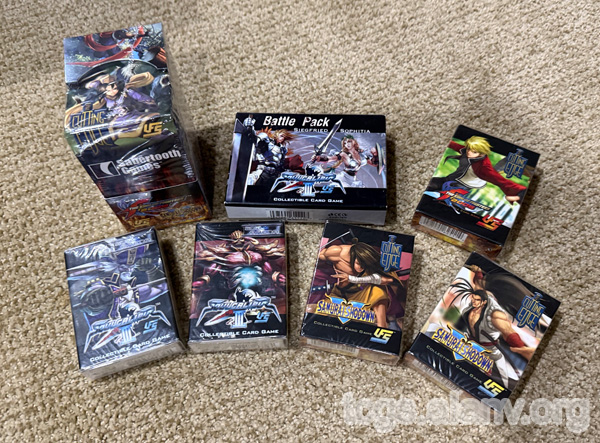
UFS (Universal Fighting System) is a card game system by Sabertooth games, combining multiple fighting games (primarily Street Fighter and Soulcalibur III, but extending to other games like SNK and Darkstalkers, and including special guest sets like Penny Arcade) into one cohesive card game. In the game, one character battles another to reduce its HP to zero.
The game is not to be confused with other similar systems like Epic Battles. It is available in one-player starter decks, two-player battle packs, and 10-card booster packs.
Technically, the game is not defunct. It passed from Sabertooth to Fantasy Flight Games, then Jasco Games, and then UVS games, and was rebranded as UniVersus in 2021 by Jasco. The modern version focuses more on anime and pop culture, with sets featuring Yu Yu Hakusho, Attack on Titan, My Hero Academia, Cowboy Bebop, Critical Role, Godzilla, Teenage Mutant Ninja Turtles, and Star Trek Lower Decks. For purposes of this writeup, we're only dealing with the original sets from Sabretooth, even though cards (despite the different card backs) are backward compatible all the way back.
Card Types
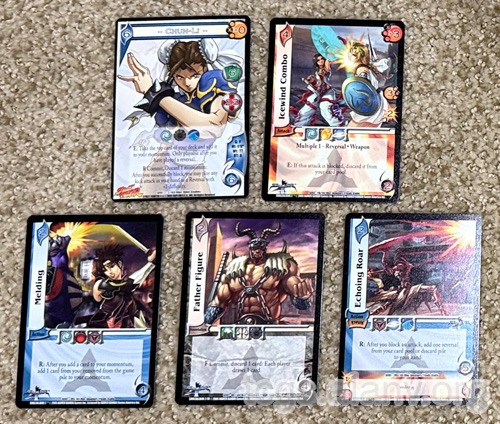
- Character - A card representing who you're fighting as. A deck is built around a character. Each includes a hand size and health, has some abilities, and has deckbuilding elemental icons.
- Action - Cards representing special abilities that can be played directly from your hand, to surprise the opponent. Each has a cost, a check value, a block value, and an effect. Each also has elements for deckbuilding.
- Asset - Cards representing useful items or allies, which provide effects while in play. Each has a cost, a check value, a block value, and an effect. Each also has elements for deckbuilding.
- Attack - Cards representing moves that characters use to hit each other. Each has a cost, a check value, a block value, a speed value, a damage value, and may have an effect. Each also has elements for deckbuilding.
- Foundation - Cards representing training or other skills to fall back on. Each has a cost, a check value, a block value, and may have an effect. Each also has elements for deckbuilding.
Cards can be dual-typed, which makes them playable as either type of card.
Sets and Decks
The game saw a ridiculous total of 22 booster sets released through 2008: Street Fighter, World Warriors, The Next Level, The Dark Path, Extreme Rivals, Fight for the Future, Domination, Deadly Ground, Warrior's Dream, Darkstalkers, Realm of Midnight, Soulcalibur III, A Take of Swords & Souls, SNK Playmore, Soul Arena, Blades of Fury, Fortune & Glory, Higher Calibur, The Cutting Edge, Flash of the Blades, The King of Fighters, Flames of Fame. Additional battle deck-only sets were also released for Penny Arcade, Soulcalibur III, and Street Fighter.
Seven of the sets had starter decks: Street Fighter, The Dark Path, Domination, Soulcalibur III, Soul Arena, SNK Playmore, and The Cutting Edge. The two-player battle decks had their own sets of cards, which were not available in any booster packs.
All booster sets include ultra-rare cards, and there were a large number of promotional cards. Foil cards are available in various sets.
(Amusingly, the Penny Arcade battle box was actually the first UFS product released, a couple months before the first actual booster set.)
Deck Composition and Contents
Starter Decks
Decks: Box Indicates Contents
Players: One
Size: Full Legal Deck
Rarities: Common, Uncommon, Starter
Rulebook: Included
Playmat: Not Included
Other Items: None
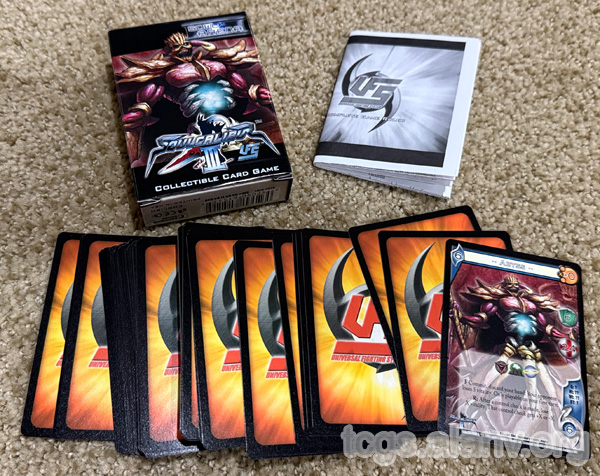
Each starter deck is themed around a specific character, and each set with starters had four different starters to choose from. Each is a 60-card deck, including three different starter-only cards (two copies of each; one of the cards is the deck's character).
Starter deck contents were semi-fixed, and the boxes indicated which deck you would get. Each deck includes 29 cards that are fixed, and an additional 31 semi-randomized cards, which consist of 20 commons and 11 uncommons. The randomized cards were selected to be compatible with the deck's character, forming a legal deck.
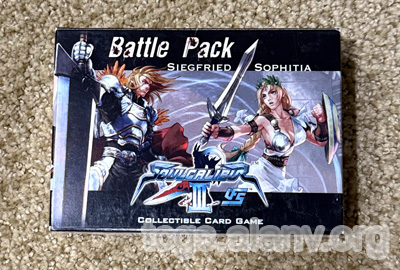
Battle Pack
Decks: All Same
Players: Two
Size: Full Legal Deck
Rarities: Starter
Rulebook: Included
Playmat: Not Included
Other Items: None
Three battle packs were available in this era of the game. Each includes two 60-card decks themed around a different character (Gabe and Tycho for Penny Arcade, Siegfried and Sophitia for Soulcalibur III, and Ryu and Akuma for Street Fighter).
All battle pack contents were fixed, and each of the same battle pack contained the same cards (i.e. all Soulcalibur III battle packs contained the same 120 cards). These cards were only available in the battle packs, effectively making them starter-only rarity, despite each card having a rarity (which mostly determined how many copies of it were included in each deck).
Deck Rarity Analysis
Excellent, all around. None of the starters are blind, meaning you can easily get all of the starter-only cards by purchasing one of each (marked) starter deck. Starters do not contain rare cards so you don't spoil any boosters. Love to see it.
Alan's Thoughts On The Game
UFS is one of my favorite games, which I unfortunately don't get enough opportunities to play.
Progressive difficulty is a mechanic that I haven't seen in any other game, making cards more and more difficult to play as you play more within a single turn. It's a fantastic card cost mechanic, which makes you question how much you want to push your luck but also providing some level of guaranteed play (if you order your plays properly). Letting you pass these checks with foundations gives an amazing level of control. Each check also costs a card from your deck, so there's an inherent resource being spent for every card play. All else aside, the card playing mechanic is probably the best I've seen in any game.
The game otherwise is amazing too, of course. Most of the cards in your deck can block (and you can partial block if your cards don't match perfectly), and blocking is always an ability on the card in addition to whatever it can normally do, meaning you're much less subject to deck screw (and instead have interesting decisions of what cards you sacrifice to block). There are a huge swath of abilities that can be used in a back-and-forth manner that can drastically change an attack by the time it actually resolves and hits (or is blocked). The use of hand size (rather than a fixed card draw) prevents hand stagnation and makes you more willing to use the cards in your hand. The use of HP (instead of your deck) lets you (mostly) control discards. Having to save foundations and decide what blocks to hold over into your opponent's turn (and then being able discard a card at the start of your next turn if you didn't end up needing it) is good. Mechanically, this is fantastic.
I do want to talk briefly about Epic Battles, which is probably the game that is thematically-closest to this one. We've talked before about how games can be more thematic versus more mechanical (such as the DBZ CCG vs DBZ TCG, or Star Trek 1E vs 2E). Epic Battles is definitely a more thematic game, featuring fairly-rapid attacks in a back-and-forth manner, and each attack resolves fairly immediately. As a result, Epic Battles games can be over in 5 minutes. UFS is a much more mechanical game, where a single attack has a ton of reaction between players before it lands. Games generally take much longer than 5 minutes. (Heck, toward the end of a UFS game, resolving a single attack can take 5 minutes, as you go through enhances.) Even just the makeup of decks reflects this: A UFS deck is typically around 1/3 attacks, and over half foundations. I'm always on the side of mechanics over theme, but I don't think it hurt UFS (in the same way it hurt DBZ TCG or Star Trek 2E) because it was a new game, without a fixed player base. That mechanical depth has served the game amazingly well through its 20 (!) years of existence, with the base rules not really changing in that time.
This isn't a page about UniVersus, but I will say that the engine has stood the test of time amazingly (how has it been almost 20 years?!), and they have managed to refine the game so much in that time that it's somehow even more enjoyable now than it was back then. The core gameplay is the same, but the game just feels like it flows more smoothly. If you're at all interested in this concept, I highly recommend you pick up some modern UniVersus products and enjoy the experience.
Overall, fantastic. The release of the Lower Decks decks has re-sparked my interest, and I'm so glad I've been able to get back into this game.
Resources
- Official Website
- universus.cards (database with every card)
- Starter Deck Card Lists (AlanvDotOrg Randomjunk)