 Publisher: Score
Summary
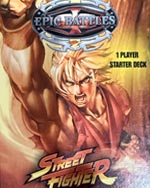
Epic Battles is a short-lived card game that attempts to simulate fighter games, using cards to punch and kick and block the other fighter. It was available in starter decks and 10-card booster packs.
The game is similar to UFS, but was not as successful. (The game was initially available exclusively through Blockbuster, which I'm sure didn't help.)
Also not to be confused with the similarly-named Ultimate Battles card game.

Card Types

- Character - A fighter that the deck is based around. Each deck has exactly one, which is not part of the deck.
- Attack - A card representing a kind of attack, such as a kick or punch. Broken into high and low attacks.
- Block - A card representing the blocking of a kind of attack. Broken into high and low blocks.
- Event - A special ocurrence that affects combat in some way.
Sets and Decks
The game had four sets released. Mortal Kombat Round One and Street Fighter Round One were released together, followed by Mortal Kombat Premier. The fourth set was Tekken 5 Round One. A fifth set (Darkstalkers) was planned but never released. The game also had a few promos.
(Yes, the set names are confusing. Mortal Kombat Premier came after Mortal Kombat Round One. Presumably a second set for Street Fighter or Tekken 5, if they had been released, would have also been called Premier.)
One-player starter decks were available for all three Round One sets, although the contents slightly differed between the Tekken 5 starter and the other starters. A Mortal Kombat two-player starter was also available, spanning both Mortal Kombat sets.
The card templates also differed fairly drastically between the properties. The two Mortal Kombat sets had the same card templates.
Also worth noting is that the game only has common and rare (no uncommon) rarities, although it does also have ultra rare cards and hidden rare cards. There's also a foil parallel set.
Deck Composition and Contents
Mortal Kombat Two-Player Starter Deck
Decks: All Same
Players: Two
Size: Two Legal Half Decks
Rarities: Common, Rare
Rulebook: Included
Playmat: Included
Other Items: None
The Mortal Kombat two-player starter deck comes with two separate decks, including two characters (Scorpion and Sub-Zero) and 29 other cards in each deck.
All two-player starters contain the same cards, including 24 common and 5 rare per deck, plus the common character card. The cards are drawn from both Mortal Kombat sets, with each deck containing cards from both Round One and Premier.
The playmat is unique to the two-player starter deck, and is Mortal Kombat themed. A rulebook (rather than a rule sheet) is included.

Street Fighter and Mortal Kombat Starter Decks
Decks: Blind Boxes
Players: One
Size: Reduced Legal Deck
Rarities: Common, Rare
Rulebook: Included
Playmat: Included
Other Items: None
Each of the Street Fighter and Mortal Kombat decks has a possible 5 characters: Ryu, Ibuki, Alex, Dudley, or Sean for Street Fighter, or Sub-Zero, Darrius, Sindel, Baraka, or Bo'Rai Cho for Mortal Kombat. The decks include one of the associated characters at random, plus 51 other cards (a legal deck is 59 cards, plus the character, for a total of 60 cards).
30 of the cards in the deck were fixed and are common across characters in the same series (i.e. all Street Fighter starters contain these 30 cards), while the other cards were specific to the character in the box. The 5 rare cards in the deck are character-specific, while the character and all other cards are common. The box does not indicate which character is included.
The playmats are common between the two (Street Fighter and Mortal Kombat), and include a card checklist (for both sets) on the back. The "rulebook" is actually a flat sheet that is the back of a poster, and is specific to the deck (Street Fighter or Mortal Kombat).

Tekken 5 Starter Deck
Decks: Blind Boxes
Players: One
Size: Full Legal Deck
Rarities: Common, Starter
Rulebook: Included
Playmat: Included
Other Items: None
The Tekken 5 starter deck includes one character card (out of a possible two: Jin Kazama or Nina Williams) and a 59 card deck (for a full legal deck of 59 cards, plus the one character). The starter also includes a rulebook and playmat.
Starter deck contents were fixed and all 60 cards varied completely by character. Seven of the cards in the deck are rare, and the character card is also rare, but all rare cards in the starter decks only appear in the starter decks, effectively making them starter-only rarity. The box does not indicate which character is included.
The playmat is Tekken 5-themed, and the back of the playmat is a poster with a card checklist.
Worth noting: The rulebook is terrible. Even though this product came after the Street Fighter and Mortal Kombat starters, the rulebook is significantly less clear to read and understand than the provided rules sheet (on the back of the poster in the other two starters), which is baffling given they literally could have copied that text word-for-word into a book. Huge negative points there.
Deck Rarity Analysis
The Street Fighter and Mortal Kombat starters are not the worst ever for rare cards, but they are pretty low in the list. Each starter deck includes multiple rares, and each rare card is provided in multiples (2 or 3 copies). If you purchase only a few starters, this can lead to disappointment when you pull those rares from booster packs. The starters, at least, all have different rares, which does not make the problem worse if you buy multiple starters.
Of course, as always, the blind nature of the starter decks, combined with the fact that there are five (!) different ones to collect for each set, means you'll likely hit a bunch of duplicate decks if you're trying to collect all five yourself. This does make the problem of rare duplication from boosters worse. (The average number of starters you need to get all 5 in a set is 12, and you could of course get much more screwed.)
The Tekken 5 starter does much better, as booster boxes claim the starter deck rares are only available in starter decks (I have not verified this personally), effectively making those "rares" into "starter only" rarities. This means you won't pull any duplicate rares from boosters, which is excellent. There are also only two different starters, meaning you'd have to have an exceedingly bad run of luck to not quickly find both of them, so you won't duplicate cards too much. (Buying just 3 starters gives you a 75% chance of getting both decks.) Really, the only way to make this better from a collector's standpoint is to mark the two decks on the outside of the box, but this is already generally fantastic.
Alan's Thoughts On The Game
This game has potential, but I think it's hindered by both the defend mechanic and energy mechanic, both of which I find to be way too subject to deck screw. You gain energy by successfully attacking (but not defending!), so bad draw luck can mean you're just utterly screwed with attacks, as you need to be able to play zero cost attacks to be able to play larger attacks. While this makes thematic sense (chaining a bunch of punches or kicks together into a bigger move), it does not work as well with a deck of cards where you do not have an open choice of what attacks to use. The attacks also scale drastically with energy cost, with a 4-energy attack doing 20 damage (1/3 of your opponent's deck!), meaning drawing attacks in the right order is extremely critical.
Speaking of defending: Block cards can only block a high or low attack, and are not usable for anything else. As the 4-energy attacks are a block-or-die scenario thanks to their ridiculous scaling, this means luck of the draw is even more important than usual... if your opponent can unleash a 4-energy attack on turn two (or even turn one), you'd better hope you have a block (and it's the right one for either high or low attacks!). The drawing of 3 cards a turn helps with this a little, but it's still extremely luck based. Starter decks also vary drastically in how many block cards they include (14/51 for SF/MK but only 8/59 in the Tekken decks!) which just tells me they have no idea what a good deck composition or an appropriate number of blocks should look like.
Additionally, damage comes from the deck, which can really screw you out of cards you need (such as 4-energy attacks and block cards). The combination of all of the above makes it feel like you're fighting your own deck more than the opponent, with the right card at the right time mattering far more in this game than in others.
It feels like the game really wanted to emulate exchanging punches and kicks until you can unleash a big attack. But the hand size and energy mechanics provide too much screw, as well as shorter combat exchanges, which really spoils this feeling.
(Incidentally, the damage on cards is almost always exactly based on the energy. Despite this being a space they could've played around in, 0 energy attacks deal 2 damage, 1 energy is 4, 2 energy is 10, and 4 energy is 20. That just feels so lazy. They did slightly more with it in the Tekken set, but it still tends to follow this pattern.)
One positive at least is that this game plays really quickly. So maybe, if you treat this as a casual side game, rather than the main event, during a games night, it could be fine.
Also worth noting: This game just isn't physically produced very well. I encountered several starter decks that had incorrect cards (such as replacing a Neck Breaker with a Back Bend, making the deck illegal with 5 Back Bend cards), the cards are almost always inserted haphazardly into the packs (with certain cards being upside down relative to the rest of the deck), and the cards themselves are also fairly thin and cheap-feeling. This doesn't really impact gameplay (assuming you don't care about illegal starter decks), but it adds to the feeling that the game just isn't good.
It's also impossible to talk about this game without talking about UFS, and UFS overall I think is a much better game. Its energy mechanic is much more satisfying (foundations plus control checks giving a push-your-luck mechanic but one that's mostly under your control), and the ability for just about any card to be used as a block (plus half damage from the wrong block zone) means there's going to be far less screw around blocking attacks. Depleting health (rather than the deck, in Epic Battles) also means damage isn't potentially screwing you out of crucial cards, and you largely control your own deck's depletion via control checks (plus an individual card feels more flexible in UFS than Epic Battles, so losing any given card isn't as critical). Momentum also feels like a better "chain" mechanic than linking. But all of that said, Epic Battles is easier to learn than UFS (with fewer "things" on the cards, and less back-and-forth during a single attack), so it's somewhat more accessible. But I don't think that tradeoff is worthwhile.
This game is very much a pass, for me.
Resources
- Fansite (includes scans of every card)
- Starter Deck Card Lists (AlanvDotOrg Randomjunk)