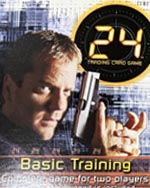
 Publisher: Press Pass
Summary
The 24 Trading Card Game was a card game published by Press Pass based around the TV show 24. In the game, you take on the role of either agents defending the people of the United States or terrorists attempting to sow discord and violence. The game was available in a 2-player starter (Basic Training), 1-player starter (Day 0 Tactical Pack), and 12-card booster packs.
This game splits its characters strongly into two alignments (CTU and Insurgents) but does not change the card backs. As such, non-character deck cards (such as equipment, agendas, and events) can theoretically be used in any deck.
Amusingly, the game has a ton of references to the number 24, from the number of deck cards to the number of points required to win, to the number of premium "elite" cards per set and the number of booster packs per box.

Card Types

- Directive - A card that represents your "goal", controlling which alignment your deck must follow, and granting a special ability or effect. These start the game in play, and are not part of your 24-card deck.
- Character - Cards representing various people who can accomplish missions. Each has a cost, alignment (CTU or Insurgents), a specialty (agent, terrorist, etc), a numeric skill (in combat, politics, etc), and health. Every card also has a "war" number.
- Equipment - Cards representing items that characters are wearing or using. Each has a cost, and may have an ability and/or a skill increase. They also have "war" numbers.
- Agenda - Cards that represent events that will happen; these play rotated, and turn every round to count down until their effect triggers. Each has a cost and effect, and also a "war" number.
- Event - Cards that represent events that are currently happening. These have a cost and an effect, and also a "war" number.
Sets and Decks
The game saw two sets released: Day 0, and First Edition. There were also a few promotional cards. Additional sets were planned (including Spec Ops, whose "elite" cards were accidentally included in First Edition boosters) but never released.
Day 0 was the "starter" set, and its cards were available either in the 2-player starter deck, or in Day 0 Tactical Packs which effectively acted as a 1-player preconstructed deck (even including a copy of the rules). First Edition was only available in booster packs.
Each set also has a set of foil parallels (taken from the set), and a set of 24 foiled "elite" cards (forming their own, separate sub-set). For First Edition boosters, foil or "elite" cards were not found in every pack, and randomly replaced another card in the pack.
(Somewhat off topic, but I hate the names they gave the sets. Day 0 is a fine name for a base set, but you can't get boosters for it, and First Edition suggests that they're the first printing of the Day 0 set rather than a separate set of cards. Unfortunately, the bad naming will continue into the starter deck products, which I'm sure added a ton of confusion to people looking to buy the game and buying a bunch of Tactical Packs when they actually wanted to be buying boosters.)
Deck Composition and Contents
Day 0 Tactical Pack
Decks: Blind Boxes
Players: One
Size: Full Legal Deck
Rarities: Starter
Rulebook: Included
Playmat: Not Included
Other Items: None
There are 6 different decks available, each themed around a specific character (Jack Bauer, Chloe O'Brian, David Palmer, Charles Logan, Nina Myers, and Phillip Bauer). Each pack includes 26 cards: a 24-card deck, a matching directive card, and a random "elite" card from the Day 0 set. As this is a full legal game deck, you can take any two Tactical packs and immediately play the game with someone.
The contents of each deck are fixed (so every Jack Bauer deck contains the same 25 cards plus a random "elite" card). The pack does not indicate which character is inside. The "elite" card is not tied to which deck you receive in any way. Each pack includes a rules sheet.
In addition to the foil "elite" card, three other cards in each pack are foiled (the directive, the character the deck is themed around, and one other card).
They really should have called these "One Player Starter Decks" or at least "One Player Preconstructed Decks", as it would have removed a significant amount of confusion around the product. A box of packs contains 12 packs.

Basic Training
Decks: All Same
Players: Two
Size: Two Full Legal Decks
Rarities: Starter, Promo
Rulebook: Included
Playmat: Included
Other Items: None
The "Basic Training" deck is a 2-player starter deck, but it's literally just the cards from the Tactical Packs for Jack Bauer and Phillip Bauer thrown into a box. To sweeten it a little, the box also includes two extra promo cards (one Jack Bauer and one Phillip Bauer) for a total of 54 cards (two 24-card decks, two directive cards, two random "elite" cards, and the two promos).
Every Basic Training box includes the same decks (50 cards) and same two promos, although the two "elite" cards are random.
The box also includes a full rulebook (rather than a fold-out sheet) and two playmats.
Deck Rarity Analysis
If we ignore the existence of the Basic Training product, the Day 0 Tactical Packs alone aren't great. I do like the fact that there's a set of cards (Day 0) that are only available through starter products, as it prevents any potential dilution of booster pack pulls. But having six different blind packs -- with no way to get (any of) those cards other than opening a correct Day 0 Tactical Pack -- is unideal. (You'd need on average 15 packs to get all 6, which is worse than even Epic Battles with its 5 different starters per set. Buying a box of 12 Tactical Packs does not guarantee you'll get all 6, either, so the PanZ solution of buying a box doesn't apply here.) The addition of "elite" cards (especially the fact that there are 24 of them) is really hurting collectors, as you need to open a minimum of 24 packs to get all the elites, which then means you're getting at least 4 copies of one of the decks (likely far more). And a legal deck is limited to two copies of a given card, so those extras are worthless to you.
But the Basic Training product knocks this from "not great" into "horrible". Every Basic Training deck you buy is spoiling two entire Day 0 Tactical Packs. Every Jack Bauer or Phillip Bauer pack you open is now practically useless to you (and totally useless after that, thanks to the 2-copies-per-deck rule). Instead of just spoiling a rare card or two, they have managed to spoil an entire 32 cards out of the 96 cards in the Day 0 set. That's a full third of the cards, and is the absolute worst spoiling I've seen across any card game.
Terrible choice to build Basic Training decks this way. This would have been improved they'd added 32 additional cards in the Day 0 set that were only found in Basic Training. It would have been completely fixed if Tactical Packs weren't blind, and instead indicated which deck you're getting. Even randomizing the Tactical Packs in Basic Training would've made it so buying multiple Basic Training decks wouldn't completely screw you. There were so many ways to make this work.
Alan's Thoughts On The Game
As a game, I actually really like 24. It plays quickly (15-20 minutes if you know what you're doing) but still has surprising strategic depth, from the choice of whether you hold characters back in the Briefing Room to reduce opponent points (and be healable) or deploy them into the field to score, to whether you block a mission at the cost of setting a character, to whether you bluff a war card, to whether you play certain Agenda cards as deterrents... they've managed to build a really good, enjoyable game even in just the 96 different Day 0 cards.
The use of "24" (both the number and the show) in different ways also actually works. A 24-card deck seems like it should be too small until you play... and it reduces the amount of deck screw you get, while still more than covering the two draws per turn you get. 24 points to victory is easy to remember. The mechanic of spending "time" to play cards makes surprising sense, and scales well. Agendas ticking down as a visible threat is fantastic. It's just a really solid game.
Unfortunately, the physical product is a huge letdown. This is the first game I've purchased (from any publisher) where the cards stuck together so badly out of the box that they were damaged when you pry them apart. (The black card edges show distinct white spots where the card material was lifted away.) The cards themselves are among the thinnest and flimsiest of any game I've encountered (and I've held a lot of TCG cards recently). The foil is badly done, and in some cases you can't even tell a card is foiled unless it catches the light just right. Within the packs, the cards seem to be inserted fairly haphazardly (similar again to Epic Battles, actually), which just adds to the feeling that this was not a product they cared about producing well.
When you combine that with the issues that the game poses to collectors (above)... I'm honestly unsurprised the game failed as badly as it did. There are way too many good, complex TCGs that a game needs something really special to attract players, the game seems to have done its best to turn away collectors, and the product naming will confuse and frustrate casual people just looking to pick up 24 cards, leaving no one left to buy it.
It's a shame, really. The game is mechanically great, and was done dirty by its publisher and whoever put together the starter products.
Resources
- Starter Deck Card Lists (AlanvDotOrg Randomjunk)