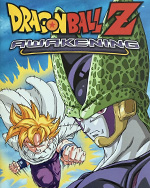
 Publisher: Panini
Summary
The Dragon Ball Z Trading Card Game (Panini iteration, often referred to as PanZ) was a card game published by Panini (who had purchased Score's card games division in 2009) from 2014 to 2017 (when the release of Dragon Ball Super killed it). It is not to be confused with the original Dragon Ball Z Collectible Card Game (ScoreZ) by Score, Dragon Ball Z Trading Card Game (ReZ) by Score, the Dragon Ball Collectible Card Game by Bandai, or the Dragon Ball Super Collectible Card Game by Bandai (phew). It was a continuation of the original CCG (ScoreZ), and was theoretically compatible with the original (but not with Score's TCG, ReZ).
Like every DBZ card game, you play as a hero or villain from Dragon Ball Z, fighting to either save the universe or destroy it. The game was available in starter decks and 12-card booster packs. A demo deck was also available.
This "continuation" greatly improves on the original CCG by formally splitting out some card types (such as ally personalities, drills, setups, and events), better symbolizing ongoing versus instant effects versus usable effects versus attacks, standardizing the attack table (which never changed throughout the run), requiring masteries (eliminating the Tokui-waza mechanic), standardizing deck requirements (exactly 60 cards with up to 3 copies of a card, regardless of name or MP or mastery or Sensei), and fixing all main personalities to exactly 4 levels (making MPP victory consistent between players).
The "compatibility" with the original CCG (ScoreZ) was much touted (to the extent that they used the original CCG card backs, which was not done even by the more-compatible DBZ GT CCG), but was always questionable due to the above changes and the general power imbalance between these cards and ones from later sets of the original. Because of this, I consider this to be a completely separate game from ScoreZ.
Much like the Star Trek and Star Wars card games, PanZ has a player-driven continuation called FanZ. Like all virtual sets, we're not counting them for purposes of this game's lifetime.

Card Types

- Main Personality - A card representing a character in the game that you play as. Each card has a level (1 to 4), a Power Up Rating (PUR), some ability, and 11 power stages (including 0). A stack of these start the game in play. Each personality is either a hero (blue background) or villain (red background).
- Mastery - A card representing your deck (and character's) style. Starts the game in play, and forces your deck to include only cards of that style (or that are unstyled), but provides a benefit to gameplay. Required, in this version of the game.
- Ally Personality - A card representing a character in the game who supports your main character. Each card has a level (always 1), a Power Up Rating (PUR), some ability, and 11 power stages (including 0). These are played from your deck. Allies do not have an inherent alignment, although certain allies can only work with certain alignments of MPs (or certain MPs).
- Physical Combat - A card representing some form of physical attack, such as a punch or a kick. Each can be an attack or defense card, has an ability, and belongs to one of six combat styles (red, blue, orange, black, Saiyan, Namekian) or is freestyle.
- Energy Combat - A card representing an energy attack, such as a beam or an energy ball. Each can be an attack or defense card, has an ability, and belongs to one of the six combat styles or is freestyle.
- Event - A card representing some happening in the game. Has an ability, and belongs to one of the six combat styles or is freestyle.
- Drill - A card representing some kind of training that provides a constant effect, and belongs to one of the six combat styles or is freestyle. These are discarded when your MP changes levels.
- Setup - A card representing some kind of event that will happen in the future, that provides an effect when activated at that point in time. Each belongs to one of the six combat styles or is freestyle.
- Dragon Ball - A card representing one of 7 Dragon Balls from a specific planet; gathering all 7 wins the game. Each has an ability.
In addition to the above game cards, booster packs could also include foil "active player" marker cards and attack table cards (which can be used as trackers for power level).
Worth noting: The card templates changed slightly between sets. Most notably, Drills and Setups were rotated (to indicate visually that they remain in play after being played) starting in the Evolution set, and Mastery cards went from rotated to vertical after Premiere, but the look of all types of cards changed (sometimes subtley) throughout the game's run.
Sets and Decks

The game saw a total of 7 booster sets released: Premiere, Heroes & Villians, Movie Collection, Evolution, Perfection, Vengeance, and Awakening. There were also a few promo cards.
Three of the sets (Premiere, Evolution, and Awakening) had starter decks, with the Premiere starters being drastically different than the other two in terms of composition.
Each set includes ultra rare cards. Sets with starter decks also include starter-only rarity cards, and the last three sets (Perfection, Vengeance, and Awakening) had Dragon Rare cards.
Deck Composition and Contents

Premiere Starter Decks
Decks: Blind Boxes
Players: One
Size: Full Unplayable Deck
Rarities: Starter
Rulebook: Included
Playmat: Included
Other Items: None
A starter deck from the Premiere set contains 4 hi-tech cards (levels 1 through 4) for one of six main personalities (Vegeta, Goku, Gohan, Krillin, Frieza, or Piccolo), along with an assigned hi-tech mastery card (a given personality always receives the same mastery card). A personality is paired with a one of two fixed 60-card decks (a given personality can have either deck). The box does not indicate which personality or deck you'll get. The box also includes 3 random foil cards from the set, and one other random hi-tech card (personality of any level, or a mastery, that is not already in the pack).
All cards (other than the foils) are starter-only rarity, and cannot be found in booster packs, and every card is unique (120 different deck cards between the two decks). However, the 60-card deck consists of cards from all six styles. As the game requires every deck to use a mastery card, and a mastery card fixes a deck to only include that style (or freestyle) cards, these starter decks are not only illegal, but technically unplayable (although the starter deck rulebook wants you to play with them anyway, I guess just not using a mastery card?). Instead, I consider these to be "collection starters" rather than "gameplay starters" (unless you choose to ignore the mastery rule to learn the game).
A rulebook and playmat are also included.

Other Starter Decks
Decks: Blind Boxes
Players: One
Size: Full Legal Deck
Rarities: Starter
Rulebook: Included
Playmat: Included
Other Items: None
Similar to Premiere, the other starters contain 4 hi-tech cards (levels 1 through 4) for one of six main personalities (Trunks, Goku, Piccolo, Vegeta, Android 17, or Android 18 for Evolution; Goku, Vegeta, Cell, Gohan, Hercule, or Trunks for Awakening), along with an assigned hi-tech mastery card (a given personality always receives the same mastery card). Each personality is paired with a full 60-card deck that matches the mastery card. The box does not indicate which personality you'll get. The box also includes 4 random foil cards from the set, and one other random hi-tech card (personality of any level, or a mastery, that is not already in the pack).
All cards (other than the foils) are starter-only rarity, and cannot be found in booster packs. The 60-card decks are fully legal and playable. A rulebook and playmat are also included.

Demo Decks
Decks: All Same
Players: Two
Size: Tiny Demo-Only Deck
Rarities: Starter
Rulebook: Included*
Playmat: Included
Other Items: Attack Table Cards
In addition to the starter decks, a demo deck was also released with the Evolution set, containing two 7-card decks with matching (level 1) MPs and masterys: Goku with a black deck, and Trunks with a Saiyan deck. The box therefore comes with a total of 18 game cards.
*Each demo deck comes with a turn-by-turn walkthrough sheet, in place of a full rulebook. It also includes two playmats and two attack table cards, which seem to be exclusive to this product.
This is interesting mostly for collectors, as it's the only way to get a non-foil non-hi-tech version of these two personality and mastery cards, and the un-foiled attack table cards. There is no reason for anyone else to acquire one of these.
Deck Rarity Analysis
The Premiere set starters actually work really well, from a rarity standpoint. Including only starter-only rarity cards means that no rares (or commons, or uncommons) are spoiled from booster packs. The fact that there are only two different starters (and these two starters do not duplicate any cards between them) means you can get a full playset (3 copies of each card) in 6 starters, if you wanted all of the personalities. (And if you don't, it should be easy to get at least one copy of each of the two 60-card decks.) A box of 10 starter decks seems guaranteed to include all 6 different starters, and therefore can provide a hard cap on how many decks you have to open. (Without such a guarantee, it would take an average of 15 decks if you're pulling each one completely at random, which is among the worst configurations.) The inclusion of one additional random starter-only hi-tech card in every starter can also mean you may luck out sooner (although it's better to treat this as a nice extra, rather than a way to get all the cards). This is one of the best configurations I've seen for collectors, but only if you buy a sealed box of 10 starters.
Evolution and Awakening are only slightly worse, but that seems like a fair price to pay for making the decks playable. Once again, all cards in the starter decks are starter-only rarity. And this time, you'll actually want all the starters (even if you're playing rather than collecting), as there are 175 and 171 cards (!) that can only be found across the 12 starters in the two sets (including the hi-tech cards). Fortunately, you're again guaranteed all 6 starters in a box of 10, putting a hard cap on your search if you're a serious collector or player. This configuration is slightly less collector-friendly than Premiere (because, while you don't really need all the personalities, you'll probably need all the deck cards), especially if you're not buying a sealed box of starters (in which case, it's almost as bad as 24 TCG, saved only by the lack of a randomized "elite" card in each starter).
(Of course, in both cases, this could have been completely fixed by marking the boxes with which personality was inside, so collecting a full set of starter-only card involved no randomness. That would have made all three starter decks completely perfect, for collectors. Oh well.)
Worth noting: Mastery cards can be found in Premiere as rare cards, and they're exact copies of the starter deck cards. This actually makes the Premiere situation better if you're a player (you don't need to buy more starters to get the mastery you need), and they're numbered differently so a collector shouldn't be too upset by this.
Also worth noting: Awakening allows you to pull all 30 starter-only hi-tech personality and mastery cards as Dragon Rare cards from packs, as regular (non-hi-tech) foils. This is a nice bonus as a player, and I'm indifferent about it as a collector.
Alan's Thoughts On The Game
As the sheer number of photos on this page suggests, PanZ is one of two games (the other being .hack//ENEMY) where I have a comprehensive and nearly-complete collection (minus promos), as I have opened booster packs from every set except Premiere, and have a full set of 6 different starters for each of the three starter products (as well as a box of demo decks). In terms of sheer number of cards, this is very much in competition with both World of Warcraft and .hack. That already gives this game a special place in my heart.
As a game... it's fine. It has a lot more complexity and interesting interactions than ReZ, and I might enjoy that if I had more opportunity to play the game, as there are more rules you have to re-remember whenever you pick it up (such as remembering to start allies at 3 stages above 0, what the "critical damage" effects are and how they trigger, and when ally actions and powers can be used). Because I hop around games (and often pull them out after years of not being touched), I've never particularly enjoyed games with a bunch of rules you just have "know", rather than them being indicated some way on the card (thank you Magic and WoW for explaining keywords), and this game feels like it has more than some others.
(As discussed on the page for ReZ, the result is that this game feels a lot more thematic and like it's giving the DBZ experience, which is certainly not a bad thing. It's just extra complexity that's less ideal if you're newly coming into it, or coming back into it.)
But that feels like very much a me problem. Overall, I think ReZ is more easily re-assessible (or accessible to new players) while this game is more interesting as a game.
Resources
- FanZ (maintains and continues to release cards for the game)
- Retro DBZ CCG (includes rules, info, and a full card listing)
- DBZ Outpost (includes rules, info, and a full card listing)
- Starter Deck Card Lists (AlanvDotOrg Randomjunk)