 Publisher: Score
Summary
The Dragon Ball Z Collectible Card Game (often called ScoreZ) was a card game published by Score around the Dragon Ball Z TV show. It is not to be confused with the Dragon Ball Z Trading Card Game (ReZ) by Score, the Dragon Ball Z Trading Card Game (PanZ) by Panini, the Dragon Ball Collectible Card Game by Bandai, or the Dragon Ball Super Collectible Card Game by Bandai (phew).
It was (somewhat) replaced by the highly-related (and mostly compatible) Dragon Ball GT Collectible Card Game in 2004. It was not the first Dragon Ball Z card game (although it was arguably the first published in English), but it is the first well-known (and most successful) one, with an impressive 11 expansions in its 4-year lifespan.
Like every DBZ card game, you play as a hero or villain from Dragon Ball Z, fighting to either save the universe or destroy it. The game was available in starter decks, preconstructed decks, and booster packs (with 9 or 10 cards, depending on the set), as well as a large number of other products like small box sets (such as Capsule Corp Power Packs).
I'm going to be honest here; I didn't really follow the game after the first set. We'll talk only about Saiyan starter decks and Trunks preconstructed decks (and no starters from other sets), but with less detail than usual, since this is not a game I ever followed up on as an adult. This writeup as a whole will also generally be less detailed than usual, as a result.

Card Types

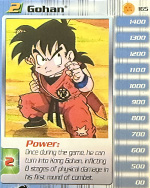
- Personality - A card representing a character in the game. Each card has a level (1 to 5), a Power Up Rating (PUR), some ability, and 11 power stages (including 0). These can be used as your main personality (starts the game in play) or an ally (starts in your deck). Each personality is either a hero (blue background) or villain (red background).
- Physical Combat - A card representing some form of physical attack, such as a punch or a kick. Each can be an attack or defense card, has an ability, and belongs to one of six combat styles (red, blue, orange, black, Saiyan, Namekian) or is unstyled.
- Energy Combat - A card representing an energy attack, such as a beam or an energy ball. Each can be an attack or defense card, has an ability, and belongs to one of the six combat styles or is unstyled.
- Combat - A card representing some other happening during combat. Each can be an attack or defense card, has an ability, and belongs to one of the six combat styles or is unstyled.
- Non-Combat - A card representing some kind of occurrence outside of combat that impacts the game. They can be used during combat after being played outside of combat, or have ongoing effects (drills), or be Dragon Balls from older sets. Each belongs to one of the six combat styles or is unstyled (or is a Dragon Ball).
- Dragon Ball - A card representing one of 7 Dragon Balls from a specific planet; gathering all 7 wins the game. Each has an ability. (In older sets, these are Non-Combat cards.)
- Mastery - A card representing your deck (and character's) style (working with a declared Tokui-Waza). Starts the game in play, and forces your deck to include only cards of that style (or that are unstyled), but provides a benefit to gameplay.
(Additional card types, such as Locations and Battlefields and Sensei cards, were introduced in later sets, after I stopped following the game, so we'll skip those.)
Sets and Decks
The game saw a total of 11 booster sets released: Saiyan, Frieza, Trunks, Androids, Cell, Cell Games, World Games, Babidi, Buu, Fusion, and Kid Buu. Additionally, plenty of promo cards and other smaller sets were available.
Four sets (Saiyan, Cell, World Games, and Buu) had starter decks, and each set had a Hero and Villain (or "Celestial Fighter", for World Games) variant of the deck.
Sets include foils, "hi-tech" foils, and ultra rare cards. Additional "uber rare" cards were available through tournaments.
Deck Composition and Contents

Starter Decks
Decks: Blind Box
Players: One
Size: Full Legal Deck
Rarities: Common, Uncommon, Starter
Rulebook: Included
Playmat: Not Included
Other Items: Quick Start Guide, Power Level Scouter, Anger Sword Counter
The Saiyan saga starter decks (and presumably other starters from other sets) included a 47 card deck (15 uncommon and 31 common cards), 3 matching personality cards (stages 1 through 3), a hi-tech card of the level 1 version of the personality, and 3 random foil cards (1 uncommon, 2 common). Each box was either a Hero or Villian (or "Celestial Fighter", for World Games), and the personality was always of the appropriate alignment.
(As the cards have been in a binder for 25 years, I have no idea whether the decks were fixed, based on the included personality, or completely randomized.)

Preconstructed Decks
Decks: Blind Box
Players: One
Size: Full Legal Deck
Rarities: Common, Uncommon, Rare, Promo
Rulebook: Not Included
Playmat: Not Included
Other Items: None
The Trunks set released Trunks Reforged preconstructed decks. Each contained 3 foil cards for a random personality (either Goku, Gohan, Vegeta, Trunks, or Piccolo), 8 other foil cards (I'm not sure whether these were fully random or based on the personality), and one of two 55-card preconstructed decks.
Each of the two decks includes 4 rare cards (in one deck, one is a Preview Rare) and either 28 or 36 uncommon cards (one being a Preview Uncommon in one deck), with the remaining cards being common (and some of those being Preview cards). (I'm not sure whether the same personality always had the same deck.)
Deck Rarity Analysis
Starters (at least for Saiyan) seem pretty good. You might have difficulty collecting all of the personality cards, but dividing the decks into heroes and villians helps with that, and the lack of any rare cards in the starters helps too. Including random foil cards was also a nice touch.
The preconstructed decks are not good, because the decks include rare cards, and there are only two fixed decks, while there are 5 different personalities to collect. As with Epic Battles, this leads to an average of 12 decks purchased to get all 5 personalities, which means lots of card (and rare) duplication. With a limit of 3 copies of most cards per deck (1 copy for allies), this is a lot of spoilerage for pulls, especially since one of the two decks includes a rare Krillin personality card.
Alan's Thoughts On The Game
Similar to Star Trek 1E, this was a game from my childhood. I eagerly purchased starter decks (one of each allegiance!) and booster packs when it came out, and even bought Burger King meals (with DBZ toys) for the included CCG cards. But it was also a game that never saw any play; despite my friends being into Dragon Ball Z, they weren't interested in playing the card game with me, so the cards sat in their boxes for years until I eventually put them into a binder, so I could at least look at them. The Trunks box of decks was purchased much later, but with the intention of collecting the cards (and putting them into the binder) rather than playing; at that point, I didn't have the original components or a rulebook on hand, so I couldn't play anyway.
Because of that, because the game is prohibitively expensive to purchase now, and because the cards carry enough nostalgia for me that I don't really want to subject the ones I have to play, this is probably one of the games I own that will never see play. Which, of course, makes it rather difficult for me to have thoughts on the game, beyond some superficial things. But I'll try anyway.
Also similar to Star Trek 1E, this very much feels like a game to me that was theme first and game second, at least initially. Several rules in the base set (Saiyan-only cards being marked as "Villains, Goku, and Gohan only", for example), the fact that Dragon Balls were standard Non-Combat cards, the attack/defense icons being hidden amongst other (decorative) symbols on the cards, and even just the punctuation of certain cards ("Fall 7 times, get up 8 times." is a card name, including a period and no capitalization, next to "It's the Little Things That Matter", no period and with caps) very much gives the impression that their priority was releasing cards, whether or not the game around it made sense.
As the game evolved, it seems to have tried to patch those issues (again, like Star Trek 1E) by introducing card types (and subtypes) and rules to clarify things like Saiyan abilities (instead of depending on cards), ending up with a game that seems to have been playable to the extent that it had a loyal following and serious tournaments. (You don't get a game with 11 expansion sets, which didn't die but was intentionally sunset, if it's an unplayable mess. Selling cards to collectors only goes so far.)
I was one of the lucky few that managed to source the (promotional!) level 4 personalities for my decks (Gohan and Nappa). But the fact that you could literally be stuck unable to fulfill one of the victory conditions of the game (Most Powerful Personality) because you didn't own the card was also kinda not great. I also think this game was particularly bad from the standpoint of power creep, with physical attack tables (for example, as a very visible measure of power creep) having 8-9 tiers ranging from 0 to 25,000+ in Saiyan, 0 to 1.3m+ in Trunks, 0 to 4m+ in Cell, and 0 to 7.3m+ in Buu (with the first stage of the table at that point being 1-349,999, well over the max in the Saiyan era).
I also have to say that this game includes the best components with its starters. No other game starter I've seen has included items as thematic as a Z-shaped scouter and a plastic sword that pulls out of its scabbard to track anger level. The hi-tech foils are also gorgeous, and a great addition to a starter deck. From a production standpoint, I think this game is incredibly well put together.
Resources
- Retro DBZ CCG (includes rules, info, and a full card listing)
- DBZ Outpost (includes rules, info, and a full card listing)
- Starter Deck Card Lists (AlanvDotOrg Randomjunk)