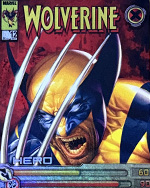
 Publisher: Upper Deck
Summary
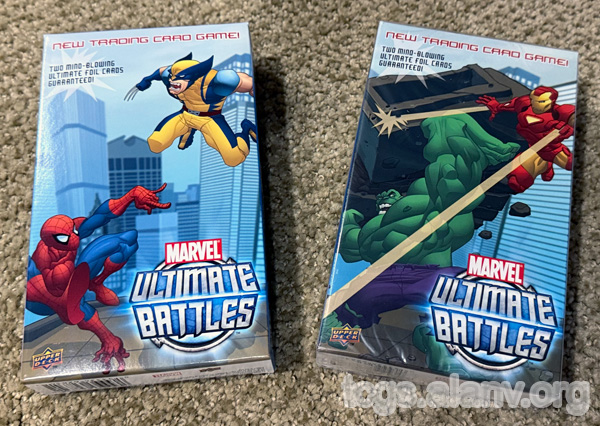
Marvel Ultimate Battles was a card game by Upper Deck (publishers of the VS System), from 2008. The game features various Marvel superheroes, and has them battle in a grid format to defeat each other. The game was distributed in 50-card starter decks and 9-card booster packs.
Not to be confused with the similarly-named Epic Battles card game, nor the similar superhero games Meta X, Marvel ReCharge, the X-Men TCG, or the VS System.
It's unclear why Upper Deck transitioned from VS to this game (or if that had been their intent), but 2008 was around the time when VS was starting to wrap up its TCG releases.
Card Types
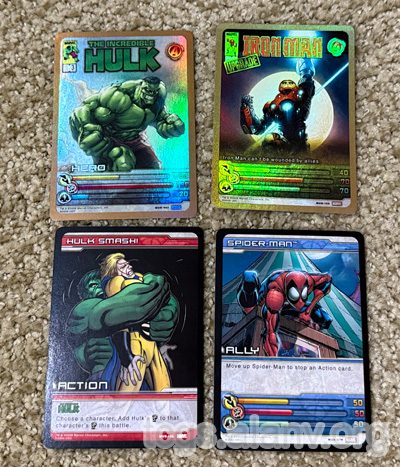
- Hero - Superhero cards you build your deck around. Each has the three stats (speed, power, and mental), and belongs to a group (like X-Men or Fantastic 4). You start the game with three heroes in play.
- Upgrade - Cards representing "better" versions of your heroes. Each has the three stats, and an ability.
- Ally - Cards representing superheroes, villains, and other helpful characters. Each has the three stats and an ability, and may belong to a group.
- Action - Cards representing special abilities. Each has an effect, and may be tied to a specific hero.
Sets and Decks
The game only had one set released. It does not feature uncommon cards, with the rarities instead being common, rare, and ultra rare. All ultra rare cards were foiled. The one set naturally has starter decks.
Deck Composition and Contents
Starter Decks
Decks: All Same
Players: One
Size: Full Legal Deck
Rarities: Common, Ultra Rare
Rulebook: Included
Playmat: Included
Other Items: None
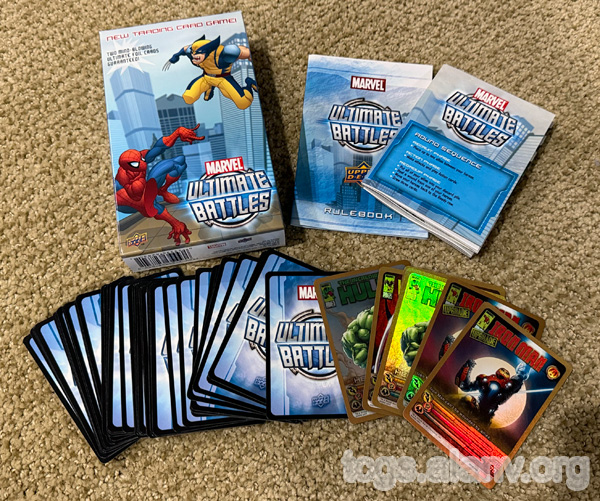
Each one-player starter deck includes 44 cards and 6 foil cards (four hero cards and two upgrade cards). This is a legal deck, which consists of 3 heroes and 45 or more deck cards.
The decks are fixed, and are almost all the same, despite there being two different possible box arts for the starter deck. All decks include the same three foil heroes (Wolverine, Incredible Hulk, and Iron Man) and two foil upgrade cards (two copies of Iron Man). The only card which may vary is the fourth foil hero card, which is a duplicate of either the foil Incredible Hulk or foil Wolverine you always receive. (Iron Man may be possible, but I have not encountered it.) These foil cards are all ultra rare, while all other cards in the deck are common.
Each deck also includes a rulebook (actually a rules sheet, which is somewhat annoying) and a playmat.
(Based on the box's statement that each deck includes "two mind-blowing ultimate foil cards guaranteed", it seems likely that the decks originally only consisted of a 46 card deck, which may have been intended to be randomized in a manner that would have included the three hero cards required to play. This is further supported by the fact that the 46-card deck is packaged separately from the 4 other foil cards and includes two foil cards, and one of the two foil cards in the 46-card deck can vary. Otherwise, you would expect the box to proudly advertise its inclusion of six foil cards.)
Deck Rarity Analysis
Yeah this is horrible. Not only does each starter deck include the same four ultra rare cards, it includes two copies of two of them. They're also mostly heroes, which you can only have one copy of in (or really, outside of) your deck, so the extra copy is useless (and extra copies from booster packs would be useless). You can include multiple copies of the upgrade card, so the two copies might be mildly useful, but that doesn't really change anything.
So every starter deck is immediately spoiling four different ultra rare cards (not even regular rare cards). I haven't opened boosters to check whether these four cards can be obtained from booster packs, but if they can, then this is really bad for collectors.
Having two different box arts on the starters also suggests that there are two different configurations of starter decks, disappointing people who buy multiple starters. Not great.
Alan's Thoughts On The Game
This is a card game that doesn't really understand what it wants to be. I won't say it's necessarily a bad game, but it certainly isn't good, which is especially disappointing given Upper Deck's literal years of experience with the excellent VS System card game.
The speed mechanic is actually interesting, and works well. The simplicity of the rules is fine. The cards are straightforward to understand (and honestly look rather nice). But there are so many things that just feel slightly wrong or underspecified. For example, when/how are action cards played when both players want to do so? Why does intercepting an attack and failing at it damage both defenders? Why do you ruin the element of surprise when you attack a face-down ally instead of having to choose an attack stat beforehand? So much feels like it's either almost there, or was a good idea that was ruined by the actual rules.
(The hero cards, though? Gorgeous. Thematic as heck, and the foiling is well done. Marvel ReCharge cheekily says its cards are suitable for (very small) framing, but I'd much rather look at (and frame) the hero cards from this game. Kudos to the graphic designers. I suppose the unnecessary duplication in the starter deck means you can have a foil Iron Man [upgrade] and Hulk [or Wolverine] to frame without making the deck unplayable. Yeah. I'm sure that's what they were going for.)
Ultimately, like many other games that have relatively simple rules (such as Marvel ReCharge, or Epic Battles), there just isn't enough meat there to make for an interesting game, and the cards themselves don't add enough complexity either.
It's a pass.
Resources
- Starter Deck Card Lists (AlanvDotOrg Randomjunk)