 Publisher: Bandai
Summary
The Teen Titans Collectible Card Game was a card game by Bandai, themed around the Teen Titans cartoon series. In the game, you control Titans (or villains) vying for control of locations (fields) and just generally engaging in combat.
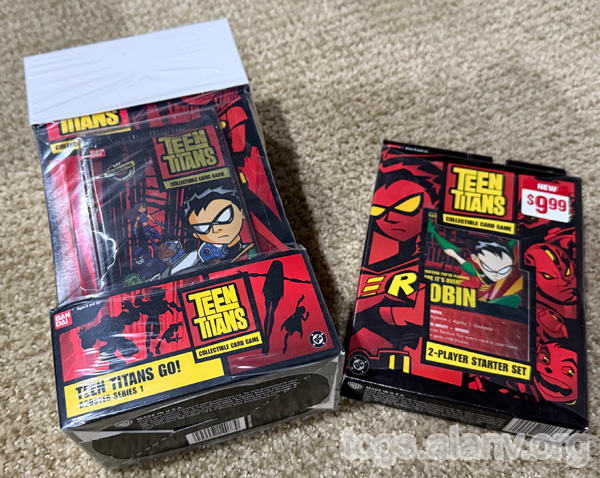
The game was distributed in starter decks and 10-card booster packs.
This game is basically the same game as the Knights of the Zodiac Collectible Card Game, just with some fundamentally necessary fixes.
Card Types
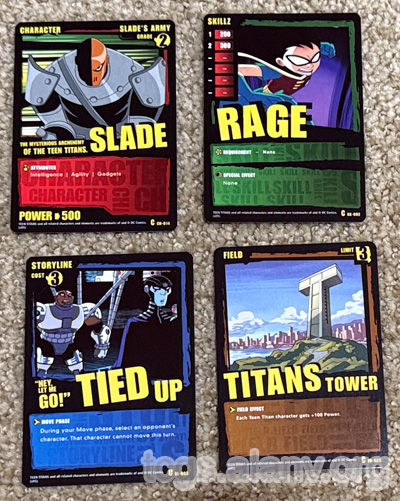
- Character - Heroes (or villains) in the series. Each has a grade, power, attributes, and an ability.
- Skillz - Abilities used by characters. Each has a power, requirement, and effect.
- Storyline - Unexpected developments in the plot. Each has a cost, effect, and a phase where they can be played.
- Field - Locations you're fighting over. Each has a limit and effect.
Sets and Decks
The game saw a total of two sets released, simply named Series 1 and Series 2. There were also promotional cards.
Series 1 had two-player starter decks. The game only has common, uncommon, and rare cards, although every booster pack also contains a foil parallel card.
Deck Composition and Contents
Starter Decks
Decks: All Same
Players: Two
Size: Two Full Legal Decks*
Rarities: Starter
Rulebook: Included
Playmat: Included
Other Items: None
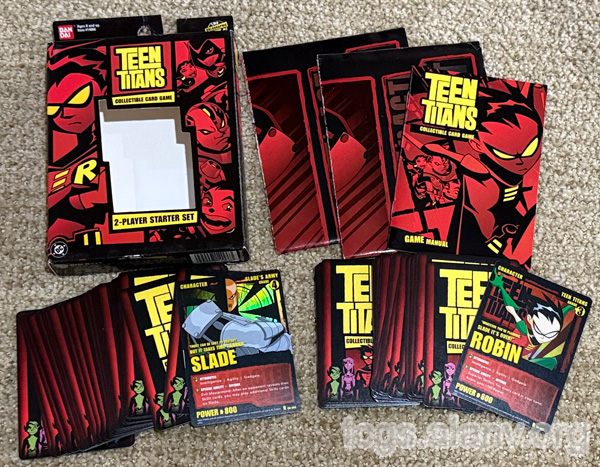
The starter deck included two 33-card decks, one for the Teen Titans and one for Slade's Army. Each is a 30-card deck plus three field cards, and one card in each (Robin and Slade) are foil.
Starter deck contents were fixed. As starter deck cards are found only in starter decks, that makes them all effectively starter-only rarity, despite each card having a marked rarity. The box also includes a rulebook and two two-sided playmats.
* The rulebook states that a legal deck is 30 cards plus 3 field cards, making the two starter deck decks fully legal decks. However, the rules were apparently later errata'd to require 50 cards, so each deck is a reduced deck under these rules. (The rulebook does not have any rules against mixing cards from different teams, and it's unclear to me whether this was also errata'd. If not, then the two decks can be used to build a full legal 50-card deck, although mixing teams does limit how you can defend field cards, so it does have a disadvantage.)
Deck Rarity Analysis
Perfect. Starter-only rarity and all decks are the same.
One complaint though: As with the Knights of the Zodiac and Gundam War card games, Bandai's card numbering system is horrible. Cards are numbered by type, and the numbering continues across sets, and there's no indication of which set a card belongs to. These cards at least indicate rarity on the card, but it again makes no sense for starter deck cards, which are all fixed anyway. I really hate how collector-hostile Bandai games are, with regard to card numbering and collector's info.
Alan's Thoughts On The Game
Okay, so a game where one player is on offense and one is on defense, and you are fighting over fields in the middle, each of which has a limit controlling who can fight there as well as how much damage the field can take. Fighting damages fields. Cards play face down. The fighters are knig....terheroes, and defeating them also grants victory points based on their leve...grade. They use techni...illz to fight. And you can play Power Of Z...toryline cards to affect the game.
Yeah, this game is just a fixed version of Knights of the Zodiac, which is a game by Bandai released the previous year.
At least they seem to have learned from the (many) failings of KotZ. The skillz require certain character attributes to use now, rather than being tied to specific characters. You can have 3 copies of a character in your deck (although it's still by card number rather than name, so certain characters can fill more of a deck than others, but this no longer matters thanks to attributes). Players alternate offense and defense instead of being stuck in those roles for an entire game (which had made half your character abilities worthless). And from the collector's side, card rarities aren't ridiculous, with the 84 possible booster pack cards being spread across only three rarities.
And actually, now that the game is fixed, it's fine. It's straightforward. It plays quickly. There's not really much long-term decision-making involved in the game (because your hand refills each turn, so you're going to burn most of your cards as cosm...action points), which means it's also a somewhat brainless game to pull out, and sometimes that's just what you want.
The fact that you play cards face down is interesting, even though it means you peek at your cards a lot, because it leads the offensive player to be a little conservative when moving to an opponent's field for the first time, and having face-down skillz can lead to a small bit of surprise (as well as some interesting reactive decisions by the defensive player).
Some other things feel a little odd as they carried over from KotZ in weird ways. For example, you can only play one character a turn, and the offensive player can only move characters to opponent fields, and it takes two turns to redeploy that character elsewhere. (The rulebook also doesn't say this, but I'm assuming the defensive player can likewise only move characters to their own fields.) This means that a character is fairly "stuck" in offense or defense mode based somewhat on what role you were when you played the character (as, if you're on offense, you're almost certainly going to want to deploy the character after playing it) despite the roles switching every turn, which wasn't an issue in KotZ as the roles were consistent for an entire game. This makes the game much less reactive than other TCGs, as it's so expensive to redeploy a character (effectively removing them from use for a turn) and it's slow to get new ones into battle (one per turn no matter what) that it feels like a lot of strategy around deployment to attack or defend is lost.
I did find the field limit numbers to be a little too restrictive, because some cards in the game play well with other cards, but their total grade is 3 or 4. Because you only get one character play per turn, and it's important to put the pressure on right away, I would always already have characters deployed at the 3 or 4 grade fields by the time I drew both halves of a combo of characters, and it wasn't worth the multiple turns it'd take to redeploy successfully (rather than just using the character to attack another lower grade field). This restriction really suggests more one-on-one battles than team battles. It's not bad, just interesting.
Overall, though, the game is just fine. It's not a game I would choose to pull out normally, or one I would want to dive particularly deep into. But it's a fun use of half an hour.
(Or maybe I'm giving it too much grace because of my shock at finding a Bandai card game that doesn't make me super sad when I try to play it. I do not have a good impression of or history with Bandai card games.)
I am however excited to find a direct example of "game mechanics that aren't designed with a particular game in mind, but also aren't a card game system", which I recently discussed in a journal post. I'm sure there are other examples of game mechanics being reused like this, but the other ones I'm aware of, like Quickstrike, are game systems, or they're simplified versions of other games like how the Arc System is just Magic Lite.
I will also say that I am a huge fan of the card design. It's extremely thematic and fitting for Teen Titans in a way that many other card game cards aren't. Especially given the visual mess that was KotZ. Huge props here.
Resources
- Starter Deck Card List (AlanvDotOrg Randomjunk)