 Publisher: Wizards of the Coast
Summary
The Star Wars Trading Card Game was a card game published by Wizards of the Coast, starting in 2002, based on the six Star Wars movies that existed at the time. You play as either the light side or the dark side and gain control of the majority of three arenas (characters, space, and ground). The game's cards are largely (but not entirely) divided into the two sides (light and dark), and the game is (more than most other games) chance dependent, involving extremely frequent dice rolls as part of combat.
The game should not be confused with the long-running Star Wars Customizable Card Game (SWCCG) produced by Decipher between 1995 and 2001, nor with Decipher's Young Jedi CCG or Jedi Nights CCG, nor the Clone Wars Adventures TCG, nor the newer Star Wars: Unlimited TCG by Fantasy Flight.
The game is available in two-player starter decks, one-player preconstructed decks, and 11-card booster packs.
* As with games such as the Star Trek CCGs or Decipher's Star Wars CCG, a player group (the Independent Development Committee, in this case) took over the game and continues releasing virtual expansion sets to this day. We're not counting virtual sets in terms of the game's lifetime, so for purposes of this discussion, the game is defunct, and ended back in 2005.
Card Types
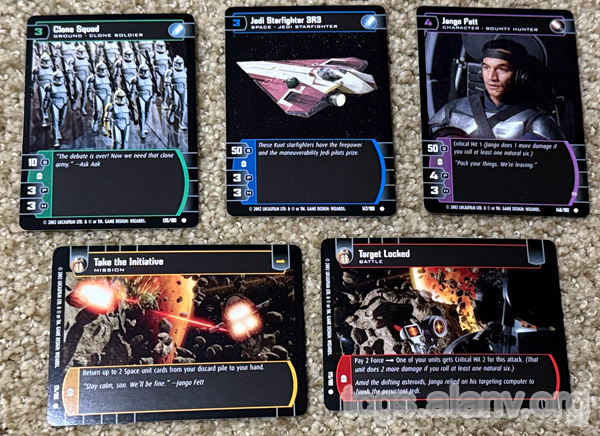
- Character Unit - A card representing an important character in Star Wars, which fights battles in the Character arena. Has a build cost, speed, power, health, and a side (light, dark, or neutral). They may have effects
- Space Unit - A card representing a spaceship in Star Wars, which fights battles in the Space arena. Has a build cost, speed, power, health, and a side (light, dark, or neutral). They may have effects
- Ground Unit - A card representing a soldier or general troops, who fight battles in the Ground arena. Has a build cost, speed, power, health, and a side (light, dark, or neutral). They may have effects
- Battle - Cards representing things that occur during combat, which can only be played during combat for an effect. They have an effect and a side, and may have a force cost.
- Mission - Cards representing goals for the game or combat, which are built and provide effects. They have a build cost, effect, and a side.
- Location - Cards representing places in Star Wars, introduced in the The Empire Strikes Back set, which have effects on a given arena. They have a build cost, effect, and a side.
- Equipment - Cards representing weapons and other upgrades in Star Wars, introduced in the (final) Revenge of the Sith set, which grant abilities to the attached unit. They have a build cost, effect, and a side, and usually attach to a specific type of unit (character, space, or ground).
Sets and Decks
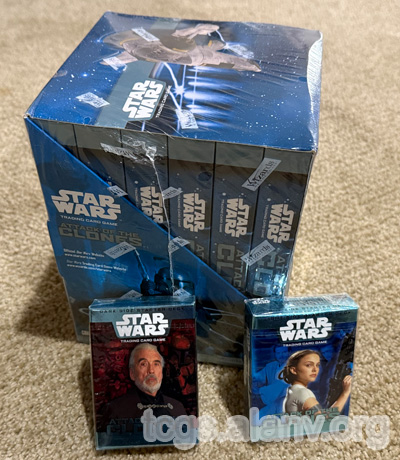
The game saw a total of ten sets released: Attack of the Clones, Sith Rising, A New Hope, Battle of Yavin, Jedi Guardians, The Empire Strikes Back, Rogues and Scoundrels, The Phantom Menace, Return of the Jedi, and Revenge of the Sith.
Two sets had two-player starter decks (Attack of the Clones and The Empire Strikes Back), and two sets had one-player preconstructed decks for each of the light side and dark side (Attack of the Clones and A New Hope). The Phantom Menace set had parallel foils (and maybe other sets?), but no set had any rarity other than common, uncommon, and rare. There were also promotional cards.
Deck Composition and Contents

Starter Decks
Decks: Box Indicates Contents
Players: Two
Size: Reduced Legal Deck
Rarities: Common, Uncommon
Rulebook: Included
Playmat: Included
Other Items: Counters, Dice
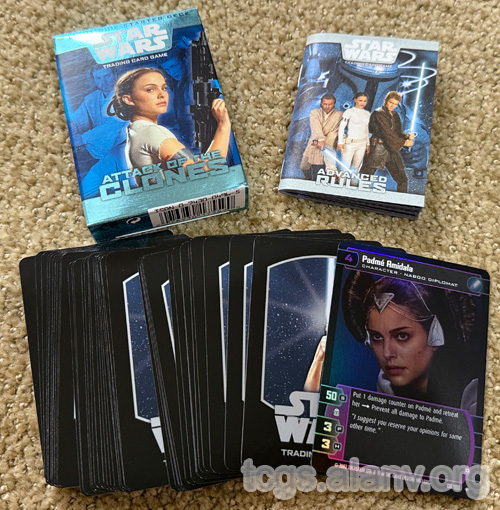
Only two sets released two-player starter decks. Each two-player starter deck came with two 30-card decks (one light, one dark), containing common and uncommon cards. (A legal deck is 60 cards.) Each 30-card deck included one special foil card. Because light side and dark side cannot be mixed, the two decks cannot be combined to form a full deck.
Decks were fixed. All two-player starter decks for a given set contained the same 60 cards.
Each deck included a game walkthrough (using specific cards from the deck) on the included playmat that helped you learn the game without needing to read the full rulebook. It also included a rulebook, damage and build counters, and dice.
Preconstructed Decks
Decks: Box Indicates Contents
Players: One
Size: Reduced Legal Deck
Rarities: Common, Uncommon
Rulebook: Included
Playmat: Not Included
Other Items: None
Two sets released preconstructed decks, and each set had one light side deck and one dark side deck, for one player. Each deck came with 40 cards, containing common and uncommon cards, and included one foil. (A legal deck is 60 cards.)
Decks were fixed, and the box indicated which deck you were getting. All of the same preconstructed decks (i.e. the A New Hope light side preconstructed deck) contained the same 40 cards.
Deck Rarity Analysis
Good. The decks all seem to include only common and uncommon cards, so you're not spoiling any rares. (It's unclear to me whether other sets had parallel foils, but if so, the decks are each spoiling a parallel foil or two. Not ideal, if so, but also mostly fine because none of the decks are blind packed, so you're not going to acquire multiple copies of those foils unless you want to.)
Alan's Thoughts On The Game
I don't like this game.
All damage in the game is die rolls to see if it hits or not, which adds an extreme amount of luck into the game. I've had a 8 power attack deal 1 damage. I've had a 3 power attack against me deal 5 (critical) damage (and knock out a crucial unit). There is way too much variance in attacks and damaging enemy units. And because of how speed works, a few lucky rolls can knock out slower (but stronger) units before they get a chance to even act.
This itself wouldn't be too big of an issue if the number of build tokens you had each turn wasn't also a die roll. We had several turns in a row where we rolled 1 or 2 build tokens, meaning no new units entered play. There are 2 and 3 cost units in the game, but the average seems to be more around 4 or 5 (and it goes up to 8 or higher). With an expected build token count of 3.5 per turn, you should expect to get less than one unit out per turn (less, because you're also theoretically building missions). Worse still, this means you can't actively react to losses... you'll start building a unit, suddenly have a huge swing against you in an arena, and be forced to switch course and start building a new unit, which puts you another turn (or more) behind on units. Plus being behind means you don't get the bonus build point for having units in all three arenas (so it's an average of 4.5 build points per turn if you're doing well). Units belonging only to specific arenas may make thematic sense, but it's extremely restrictive when it comes to actual play.
All of this together makes the loss of units due to bad rolls incredibly impactful, and what starts out as a fair fight with evenly deployed units (from the 30 points (!!) of building you do before play starts) can quickly grow lopsided... and once it's lopsided, all you can do is retreat and give up control of that arena, or keep the units there but expect they'll be picked off one by one. There is far, far too much variance on unit damage in this game for me.
The battle cards can help this, somewhat... but you need to draw them. And you only get one card draw a turn. Because units are so important to the game, the vast majority of your deck will be units, and you often find yourself with a hand full of unit cards that you aren't getting nearly enough counters to build, while battle cards that can actually help prevent damage are few and far between. This deck variance may be a normal part of card games, but it feels even more pronounced here where damage prevention is so critical.
I'm sure, when you've played the game enough, there's strategy you can develop around retreating. I'm sure you can build a deck that has effects that will help fix card draws. There are probably ways to accelerate building. But my initial few experiences were negative enough that I have no desire to develop that level of skill with the game.
I'd much rather play games without dice, especially this number of dice. The extreme variance adds nothing to this game but frustration.
(Also, while we were playing this, the table was utterly full of dice and counters, tracking things like force and damage and build counters, and being used by the handful every time an attack occurred. It wasn't a "fun" table is full, but rather a "why did we pull all of this stuff out for this gameplay experience" table is full.)
Perhaps that just means I'm not the target audience for this game. Perhaps this is a better game for people who play and enjoy tabletop games. Perhaps others will enjoy the feeling of getting lucky on an attack or having to recover from a bad roll. But that isn't me. My friend described this game as "uncompelling", and I think that's a great word for it, so it's a definite pass for me.
Resources
- Independent Development Committee
- Starter Deck Card Lists (AlanvDotOrg Randomjunk)