 Publisher: Decipher
Summary
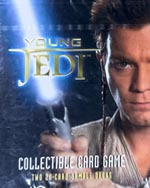
The Young Jedi Collectible Card Game (notably not customizable, like other Decipher CCGs) was a Star Wars-themed card game by Decipher. It was set specifically in the Episode One film, and primarily featured Obi Wan Kenobi and Darth Maul. In the game, you play as various major and minor (mostly minor) characters, who fight each other for control of three planets: Naboo, Tatooine, and Courscant. The game was distributed in starter decks and 11-card booster packs, plus a few other products.Unlike many games (and like Decipher's Star Wars Customizable Card Game), the game is divided into two completely distinct factions with different card backs: the light side (blue, Obi Wan-backed cards) and the dark side (red, Darth Maul-backed cards).
The game should not be confused with the long-running Star Wars Customizable Card Game (SWCCG) also produced by Decipher between 1995 and 2001, nor with their Jedi Nights CCG, nor the Clone Wars Adventures TCG, nor Wizard of the Coast's Star Wars TCG, nor the newer Star Wars: Unlimited TCG by Fantasy Flight.
* As with other Decipher games such as the Star Trek CCGs or the Star Wars CCG, a player committee (literally the Players Committee, in this case) continued producing expansion sets, although only two sets were released, and this ended in 2002. We're not counting virtual sets in this game's lifespan.

Card Types

- Character - Cards representing various characters in the Star Wars universe, such as Obi Wan Kenobi. Each card specializes in one the three planets, and may be stronger in a specific location on that planet. Each card also has a cost, a power, a damage amount, and potentially an effect. Some characters are "stackable". All cards include a "destiny" value.
- Weapon - Cards representing items that characters can use, typically to boost their power during combat. They may also have other effects. They all have a cost and, of course, a "destiny" value.
- Battle - Cards representing special moves or events during battle. These are used as part of combat to add power or additional effects. They all have a "destiny" value.
- Effect - Cards representing various events, with various effects on gameplay. These each have a cost, an effect, and a "destiny" value.
- Location - One of three places on each of three planets. These represent the location where the characters are fighting. They also have a "destiny" value.
- Starship - Either transport or starfighter ships. These are used to either evacuate cards from a planet, or to fight a transport evacuating cards. They have a power, a damage amount, and a "destiny" value.
- Objective - Introduced only in the last set, provides an alternate way to win the game.
Sets and Decks

The game saw a total of five sets released: Menace of Darth Maul, The Jedi Council, Battle of Naboo, Duel of the Fates, and Boonta Eva Podrace. There was also a Reflections set, several "enhanced" products (extra cards plus boosters), and promotional cards.
The first three sets (Darth Maul, Jedi Council, Naboo) had 2-player starter decks released with them. They were also significantly larger sets (140 cards each, compared to 60 in the other two expansions). Each set is extremely brightly colored (red, blue, green, purple, and orange, respectively) and its products are therefore always clearly identifiable.
The first three sets only have common, uncommon, rare, and starter-only rarities. The other two sets replace starter-only rarity cards with ultra-rare cards (2 per set). Each set also has foil cards.
Worth noting: The first three sets seem designed to work together as a single (huge) 420-card base set. The cards within are all fairly well balanced with each other (unlike the latter two sets) and you need all three sets' starter decks to get all 9 locations for each faction.
Deck Composition and Contents

Starter Decks
Decks: All Same
Players: Two
Size: Two Legal Half Decks
Rarities: Common, Starter
Rulebook: Included
Playmat: Not Included
Other Items: None
The three starter decks (for the first three sets) all had the same structure. Each included two 30-card decks (one light side, one dark side), 5 cards of which were Location cards (3 of the same card for the planet focus of the set; Tatooine for Darth Maul, Courscant for Jedi Council, Naboo for Naboo; and one location for each of the other two planets). An impressive 10 cards in each deck (20 total) are starter-only rarity.
Any two starter decks can be combined to form two complete legal 60-card decks for each side. All starter decks for a given set contain the same 60 cards. The decks do not contain foil cards.
One noteworthy thing: Starter decks are the only way to obtain Location cards. These are not found in booster packs, and there are only 9 different Location cards in the game (18 total cards, since they are duplicated between the light side and dark side backs). In this manner, you must purchase all three starter decks to obtain all 9 locations.
Also noteworthy: The rulebooks in each deck are heavily themed to the set, including varying the images of the cards in the example playfields to reflect cards in that set.
Deck Rarity Analysis
This is an interesting one. If you take only deck rarities into account, this game is fantastic. As good as it gets. Putting Location cards (of which you will only ever need at most one copy of each of the 9 cards) in starter decks is the best possible way to make it so you'll never pull them from boosters (wasting a spot for a card you could actually use). (The other way to do this would be what World of Warcraft did, by including a hero in every booster, therefore making it not take a slot from anything else.) The 5 other starter-only rarity cards in each deck are a nice bonus. The decks otherwise contain only common cards, making it so every pull from boosters (even uncommons!) are exciting. So good.
The problem is the makeup of cards within those 30-card decks: Like the Austin Powers CCG starters, cards are duplicated like heck. You'll get 5 copies of three cards, so half your deck is three different cards. Of the remaining 15, you get 4 copies of a card, 3 copies of two others, and 2 of another. This duplication is ridiculous, and there frankly doesn't seem to be any reason for it either. They seem to have acknowledged that players will want the "big" characters, so every deck includes (a single) Obi Wan or Darth Maul card, but they could have easily added singles of other characters like Padme or Anakin or (yes) even Jar Jar. Even the demo decks have a better composition in its 20 cards per side, with 12 of the 20 cards being singles. They should have also included a transport and starfighter ship; this would've been trivial as it would've replaced two copies of the three-copy location card, and made the full game actually playable with combined starter decks, instead of forcing you to leave cards stranded on planets with no recourse.
From a rarity standpoint, none of this is a big deal (I guess you'll be sad to pull a copy of the common card you already have 5 copies of, but it's common, so whatever) but it still doesn't feel good to open a starter and repeatedly see the same few cards. They could have done far better.
Alan's Thoughts On The Game
This game is great, if you go into it not expecting it to be something it's not. And what it is is a hand-combat focused game between different characters, with a few other loosely themed mechanics taped on. (For example, you could frankly ignore the entire transport evacuation mechanic and just evacuate a planet for free, as that mechanic adds little more than flavor and is so heavily luck-reliant anyway.)
My experience with this game is limited to the first three sets, which may be for the better, as I hear the other sets add some questionable mechanics (dueling and podracing) and have rather gamebreaking effects (like cards that search your deck for other cards, making it trivial to build a battle army; a much bigger deal in a game that plays so quickly and where cards are relatively individually underwhelming).
But as far as the first three sets go, it plays quickly and is relatively satisfying. Having 6 "counters" to spend per turn, combined with an "evening up" mechanic rather than a simple draw mechanic, means you can dump a lot of cards into play quickly and easily, or save up for a bigger hitter. The battle cards add an interesting enough twist that can turn the tide. The mechanic to move to a new world helps the player who just lost and gives them a chance to recover. The deckbuilding mechanic (10 cards of each of 6 colored dots) is a great way to ensure relative balance within decks.
I do find it extremely interesting that this is a game where it is literally impossible (not just highly expensive) to build a deck (legal or not) without buying a starter deck, as Location cards are required to play the game, and those can never be found in booster packs.
Resources
- Star Wars Player Committee
- Starter Deck Card Lists (AlanvDotOrg Randomjunk)